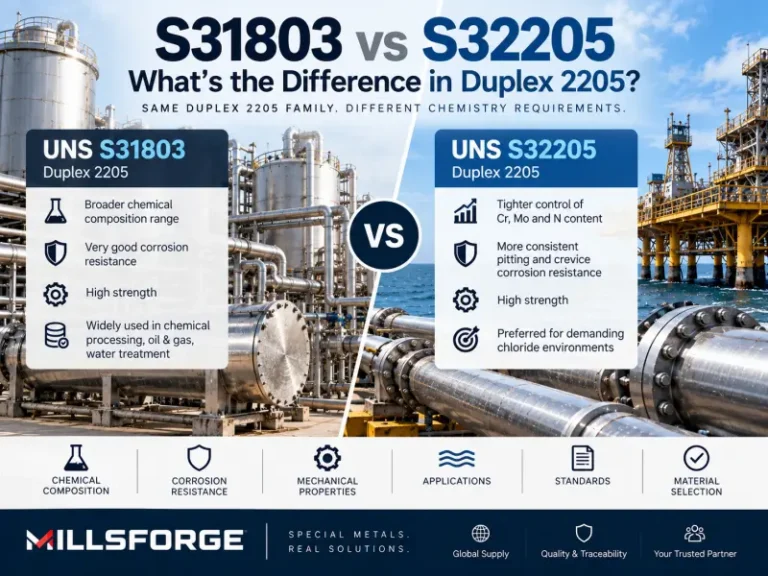
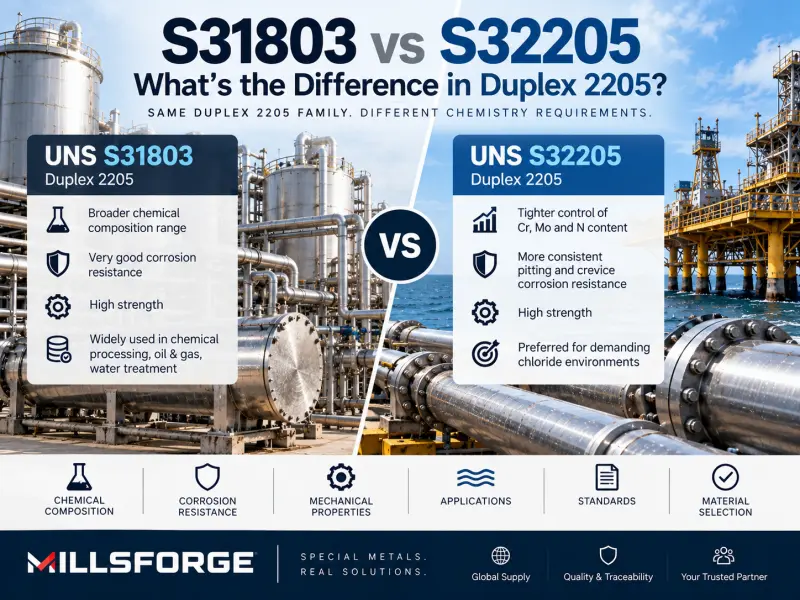
UNS S31803 and UNS S32205 are closely related duplex stainless steel grades commonly referred to as Duplex 2205.
They share the same general 22Cr-5Ni-3Mo duplex alloy concept and are both commonly associated with EN 1.4462. However, they are not technically identical.
The key difference is that UNS S32205 has tighter minimum requirements for chromium, molybdenum and nitrogen, effectively representing the higher-alloyed portion of the broader S31803 composition range.
This tighter chemistry was introduced to provide more consistent pitting and crevice corrosion resistance, particularly in chloride-containing environments. Outokumpu describes S32205 as having an alloying range limited to the upper end of S31803 with respect to Cr, Mo and N.
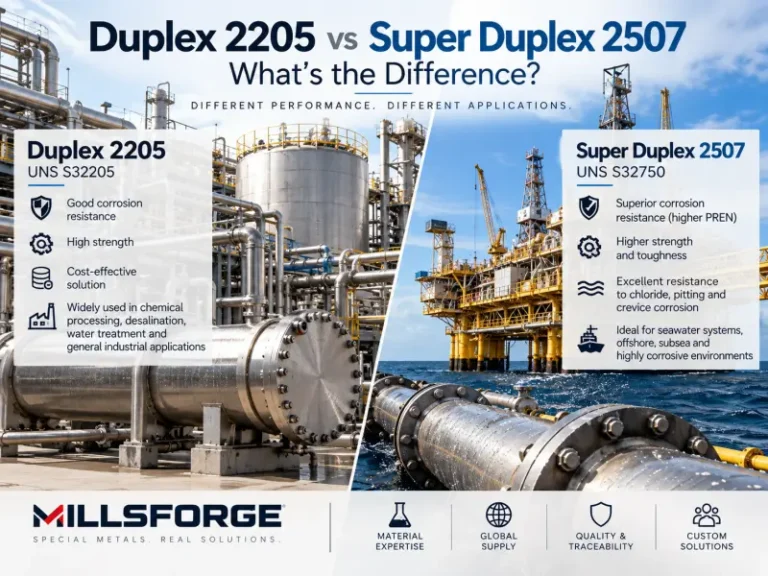
Duplex 2205 vs 2507: Which Should You Choose?
A practical material-selection framework looks like this:
| Requirement | 2205 | 2507 |
| General industrial corrosion | ✓ | ✓ |
| Moderate chloride service | ✓ | ✓ |
| High chloride concentration | Consider | Strong candidate |
| Seawater service | Evaluate carefully | Common choice |
| High pitting resistance | Good | Excellent |
| PREN >40 required | ✕ | ✓ |
| Higher mechanical strength | Good | Better |
| Lower material cost | Usually favorable | Higher alloy content |
| Offshore / subsea | Application dependent | Commonly specified |
| ASTM A182 F51 required | ✓ | ✕ |
| ASTM A182 F53 required | ✕ | ✓ |
The important point is not that 2507 is always the better material.
If Duplex 2205 provides adequate corrosion resistance and mechanical properties for the design conditions, moving to 2507 may add unnecessary alloy cost and fabrication requirements.
Conversely, selecting 2205 purely to reduce material cost can be a poor decision if the service environment requires the additional localized corrosion resistance of 2507.
What Is UNS S31803?
UNS S31803 is one of the original specifications for Duplex 2205 stainless steel.
It is a duplex stainless steel with approximately equal proportions of ferrite and austenite after appropriate solution annealing and fabrication.
Typical characteristics include:
- High mechanical strength
- Good resistance to chloride stress corrosion cracking
- Good resistance to general corrosion
- Good resistance to pitting and crevice corrosion
- Good erosion-corrosion resistance
- Good weldability
Compared with conventional austenitic stainless steels such as 316L, S31803 offers substantially higher strength and improved resistance to chloride stress corrosion cracking.
Alleima lists SAF 31803 as a duplex stainless steel with a typical PRE above 31, while also noting significantly improved chloride resistance compared with conventional 304 and 316 stainless steels.
What Is UNS S32205?
UNS S32205 is also Duplex 2205, but with a more tightly controlled chemical composition.
The important difference is that its chemistry requires higher minimum levels of the alloying elements most important for localized corrosion resistance:
Chromium
Molybdenum
Nitrogen
Modern Duplex 2205 products are therefore frequently manufactured to S32205 chemistry.
For example, Outokumpu lists its Forta DX 2205 as complying with both UNS S31803 and UNS S32205, with a typical composition of approximately 22.4% Cr, 5.7% Ni, 3.1% Mo and 0.17% N.
Alleima similarly lists its 2205 products to both S31803 and S32205, with nominal chemistry around 22.5Cr-5.5Ni-3.2Mo-0.18N.
Chemical Composition: The Main Difference
The most important distinction between S31803 and S32205 is the allowable chemistry.
S31803 has a broader composition window.
S32205 narrows that range by increasing the minimum levels of several key elements.
A simplified comparison is:
| Element | S31803 | S32205 |
| Cr | 21.0–23.0% | Higher minimum within 2205 range |
| Ni | Approx. 4.5–6.5% | Similar general range |
| Mo | 2.5–3.5% | Higher minimum |
| N | 0.08–0.20% | Higher minimum |
| C | ≤0.03% | ≤0.03% |
The practical consequence is important: A material can comply with the broader S31803 chemistry while containing lower Mo or N than would be desirable for optimized 2205 corrosion resistance.
S32205 was therefore created to tighten control over these elements.
Outokumpu describes S32205 as the upper-alloyed part of S31803 in terms of chromium, molybdenum and nitrogen.
Why Were Two UNS Numbers Created?
Historically, Duplex 2205 was first standardized as UNS S31803.
However, experience showed that material produced toward the lower end of the permitted S31803 chemistry could have lower pitting resistance than material produced toward the upper end.
This is particularly relevant for:
- molybdenum
- nitrogen
- chromium
These elements strongly influence localized corrosion resistance.
S32205 was therefore introduced with tighter lower limits to provide more consistent corrosion performance.
This is why, in modern specifications, you often see: UNS S32205 / S31803
or S32205 dual certified to S31803
rather than S31803 alone.
PREN Difference
One of the clearest ways to understand the difference is through the Pitting Resistance Equivalent Number, or PREN.
A commonly used formula is:
PREN = %Cr + 3.3 × %Mo + 16 × %N
Since S32205 controls Mo and N more tightly, it normally provides a more consistent PREN.
Alleima gives the following representative comparison:
SAF 31803: PRE >31
SAF 2205 / S32205 chemistry: PRE >35
This does not mean every S31803 heat has poor corrosion resistance.
Rather, it means the permitted S31803 chemistry allows a wider performance range.
That is the real reason S32205 became widely preferred.
Corrosion Resistance
This is where the difference between 2205 and 2507 becomes most important.
Duplex 2205
2205 provides very good resistance to:
- General corrosion
- Chloride stress corrosion cracking
- Pitting
- Crevice corrosion
- Erosion corrosion
- Corrosion fatigue
It offers considerably better chloride performance than conventional 304 and 316 stainless steels in many environments.
Super Duplex 2507
2507 takes localized corrosion resistance considerably further.
It provides excellent resistance to:
- Chloride-induced pitting
- Crevice corrosion
- Chloride stress corrosion cracking
- Erosion corrosion
- Corrosion fatigue
- Many aggressive process environments
Its higher PREN makes it particularly attractive for seawater, high-chloride brines and demanding offshore environments.
Are the Mechanical Properties Different?
The answer depends on the product standard.
The chemistry specifications are not the only requirements controlling mechanical properties; the relevant ASTM, ASME or EN product specification also defines strength, elongation and heat-treatment requirements.
Outokumpu shows, for example, different minimum tensile values in some ASME product contexts, with S32205 receiving tighter or higher specified values than S31803 depending on the governing specification. Outokumpu
For procurement purposes, you should therefore not select material based only on the UNS number.
You should specify the full product standard, for example: ASTM A240 UNS S32205
or ASTM A182 F51 / UNS S32205
depending on the product form.
Is S32205 Better Than S31803?
From a chemistry-control standpoint, S32205 generally provides a more consistent corrosion-resistance margin.
That does not mean an S31803 heat is automatically inferior.
A particular S31803 heat may have chemistry that also meets S32205.
In fact, many modern Duplex 2205 products are manufactured to chemistry that satisfies both UNS S31803 and S32205.
This is why dual certification is common.
The important question is therefore not: “Which grade name is better?”
but rather: “Does the actual heat chemistry and product specification meet the required corrosion and mechanical properties?”
Welding and Fabrication
Both 2205 and 2507 have good weldability when suitable welding procedures are followed.
However, duplex stainless steel welding requires careful control of:
heat input, interpass temperature, filler metal, shielding gas, cooling conditions and phase balance.
The goal is to maintain an appropriate balance between ferrite and austenite while avoiding detrimental intermetallic phases.
This becomes especially important with Super Duplex 2507 because poor welding or heat treatment can reduce the corrosion performance expected from the higher-alloy material.
In critical offshore and oil & gas projects, the material specification may therefore require additional controls such as:
ferrite testing, PMI, ASTM G48 corrosion testing, impact testing, NDE and qualified welding procedures.
The applicable project specification should define the required tests and acceptance criteria.
Can S32205 Be Dual Certified as S31803?
Often, yes.
Because S32205 chemistry falls within the broader S31803 composition envelope, a heat meeting S32205 requirements may also meet S31803 requirements.
Manufacturers commonly issue material certificates showing: UNS S31803 / S32205
when the material satisfies both.
Outokumpu markets Duplex 2205 as both UNS S31803 and S32205, while Alleima likewise lists both UNS designations for its modern 2205 products.
However, dual certification should be confirmed from the actual MTC / EN 10204 3.1 certificate, not assumed from the commercial description alone.
Is S31803 the Same as 1.4462?
In European material designation systems, EN 1.4462 is commonly associated with Duplex 2205.
Modern supplier datasheets commonly list:
UNS S31803 / S32205
EN 1.4462
X2CrNiMoN22-5-3
for Duplex 2205.
However, procurement documents should still reference the exact required standard because EN and ASTM/UNS systems are not simply interchangeable labels.
What About ASTM A182 F51?
This is particularly relevant for MillsForge customers buying:
- flanges
- forged fittings
- rings
- forged blocks
- valve bodies
For forgings under ASTM A182, Duplex 2205 is commonly supplied as Grade F51.
Alleima states that its 2205 billet is suitable for manufacturing ASTM A182 F51/F60 forgings and analyzes the material to S31803/S32205.
So you may encounter a purchase description such as: ASTM A182 F51, UNS S32205, ASME B16.5
or: ASTM A182 F51, UNS S31803/S32205, EN 10204 3.1
The exact specification should be reviewed against the project requirement.
Typical Product Forms
S31803/S32205 Duplex 2205 is widely available as:
| Product Form | Common Standard |
| Plate / Sheet | ASTM A240 |
| Pipe | ASTM A790 |
| Tube | ASTM A789 |
| Forgings / Flanges | ASTM A182 |
| Butt-Weld Fittings | ASTM A815 |
| Bar | ASTM A276 / A479 |
| Hollow Bar | ASTM A790 or applicable EN specification |
Outokumpu lists Duplex 2205 in plate, hot-rolled coil and cold-rolled coil, while Alleima supplies S31803/S32205 across tubular, bar and billet product forms.
S31803 vs S32205: Which Should You Specify?
For a new project where Duplex 2205 is required, S32205 is commonly the more precise modern specification because it controls the critical alloying elements more tightly.
| Requirement | S31803 | S32205 |
| Duplex 2205 family | ✓ | ✓ |
| EN 1.4462 commonly associated | ✓ | ✓ |
| Broad historical specification | ✓ | — |
| Tighter Cr/Mo/N control | — | ✓ |
| More consistent PREN | Good | Better controlled |
| Dual certification commonly available | ✓ | ✓ |
| Modern project specification | Accepted where specified | Frequently preferred |
If a customer’s specification explicitly requires UNS S32205, supplying material certified only as S31803 should not automatically be treated as equivalent.
Always verify the MTC and applicable product specification.
Conclusion
The difference between UNS S31803 and UNS S32205 is subtle but important.
Both belong to the Duplex 2205 family, and both are commonly associated with EN 1.4462. However, S32205 tightens the permissible chemistry—particularly chromium, molybdenum and nitrogen—to provide more consistent resistance to pitting and crevice corrosion.
In practical procurement terms:
S31803 = original, broader Duplex 2205 chemistry
S32205 = tighter, optimized Duplex 2205 chemistry
Today, many Duplex 2205 products are manufactured to satisfy both specifications and are supplied as S31803/S32205 dual certified material.
For critical purchases, the actual material certificate, heat chemistry, product specification, heat treatment and project requirements should always be reviewed rather than relying only on the commercial name “2205.”
FAQ
Not exactly.
Both are part of the Duplex 2205 family, but S32205 has tighter chemistry requirements, particularly for chromium, molybdenum and nitrogen.
S32205 was developed to ensure more consistent localized corrosion resistance by preventing the alloy from being produced at the lower end of the original S31803 Mo and N ranges.
Often yes.
Because S32205 occupies a tighter range within the broader S31803 chemistry envelope, many modern heats are dual certified.
PREN depends on actual chemistry. Representative Alleima data shows S31803 above approximately 31 and optimized S32205/2205 chemistry above approximately 35.
Yes. Both UNS S31803 and S32205 are commonly marketed as Duplex 2205. Outokumpu lists its Forta DX 2205 under both UNS designations.
No.
S32205 is Duplex 2205, not super duplex.
Common super duplex grades include:
UNS S32750 — Super Duplex 2507
UNS S32760 — Super Duplex
These typically have PREN values above 40 and substantially higher Cr, Mo and N contents.
Not automatically. The substitution should be reviewed against corrosion conditions, design requirements, applicable standards and the project specification. Where F53/S32750 or a minimum PREN above 40 is explicitly required, ordinary 2205/F51 would not satisfy that material requirement.