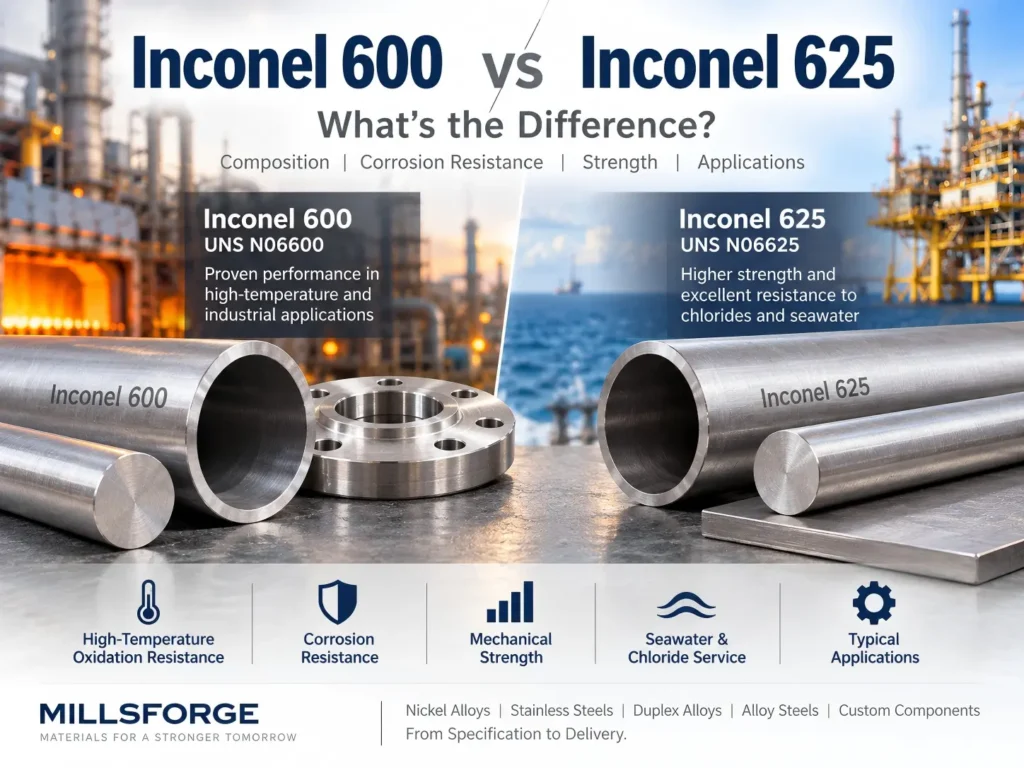
Inconel 600 and Inconel 625 are both nickel-based alloys designed for demanding environments involving high temperatures and corrosion. However, their chemical compositions, mechanical strength, corrosion resistance, and typical applications are significantly different.
Inconel 600 (UNS N06600) is a nickel-chromium-iron alloy particularly well known for its high-temperature oxidation resistance and long service history in furnace, heat-treatment, chemical-processing, and thermal applications.
Inconel 625 (UNS N06625) contains significant additions of molybdenum and niobium, giving it substantially higher strength and excellent resistance to pitting, crevice corrosion, seawater, and many chloride-containing environments.
The correct choice therefore depends on the actual operating environment rather than simply selecting the alloy with the higher number.
Quick Comparison: Inconel 600 vs 625
| Property | Inconel 600 | Inconel 625 |
| UNS Number | N06600 | N06625 |
| Alloy System | Ni-Cr-Fe | Ni-Cr-Mo-Nb |
| Nickel | ≥72% | ≥58% |
| Chromium | 14–17% | 20–23% |
| Molybdenum | — | 8–10% |
| Niobium + Tantalum | — | 3.15–4.15% |
| Corrosion Resistance | Very Good | Excellent |
| Pitting / Crevice Corrosion | Moderate to Good, depending on environment | Excellent |
| Chloride / Seawater Service | More limited than 625 | Excellent |
| High-Temperature Oxidation | Excellent | Excellent |
| Mechanical Strength | Moderate | Significantly Higher |
| Typical Applications | Furnaces, heat treatment, chemical processing | Marine, offshore, chemical processing, aerospace |
Which Should You Choose?
Consider Inconel 600 when the primary requirements involve:
- High-temperature oxidation resistance
- Furnace service
- Heat-treatment equipment
- Established Ni-Cr high-temperature performance
- Corrosive environments where the additional Mo/Nb benefits of Alloy 625 are not required
Consider Inconel 625 when the application involves:
- Seawater
- Marine or offshore environments
- Aggressive chlorides
- Pitting or crevice corrosion
- Higher mechanical strength
- Severe chemical-processing conditions
The selection should ultimately be based on temperature, process chemistry, chloride concentration, mechanical loading, applicable material specification, and design requirements.
Inconel 600 vs 625 for Different Applications
| Application | General Consideration |
| Furnace Components | Alloy 600 widely used |
| Heat-Treatment Equipment | Alloy 600 widely used |
| High-Temperature Oxidation | Both should be evaluated for actual conditions |
| Chemical Processing | Depends on process chemistry |
| Chloride-Rich Service | Alloy 625 generally provides stronger localized-corrosion resistance |
| Seawater | Alloy 625 widely used |
| Marine Equipment | Alloy 625 widely used |
| Offshore Equipment | Alloy 625 commonly specified |
| High Mechanical Loads | Alloy 625 provides substantially higher strength |
| Pitting / Crevice Corrosion | Alloy 625 generally has a significant advantage |
These are general material-selection considerations. Actual corrosion rates, temperature limits, stresses, fabrication conditions, and applicable design codes should be evaluated for each application.
What Is Inconel 600?
Inconel 600, designated UNS N06600, is a nickel-chromium-iron alloy combining corrosion resistance with excellent resistance to oxidation at elevated temperatures.
Its high nickel content contributes to resistance against many reducing environments, while chromium provides oxidation resistance.
Typical applications include:
- Furnace components
- Heat-treatment equipment
- Chemical-processing equipment
- Heater components
- High-temperature piping and components
- Nuclear and thermal applications
- Industrial process equipment
Inconel 600 is particularly valued where high-temperature oxidation resistance, corrosion resistance, and fabrication characteristics are required together.
What Is Inconel 625?
Inconel 625, designated UNS N06625, is a nickel-chromium-molybdenum alloy containing significant niobium.
The combination of molybdenum and niobium provides strong solid-solution strengthening, allowing Alloy 625 to achieve considerably higher mechanical strength than Alloy 600 without relying primarily on precipitation-hardening heat treatments.
Its alloy chemistry also provides excellent resistance to localized corrosion.
Typical applications include:
- Offshore equipment
- Marine components
- Seawater piping
- Chemical-processing equipment
- Heat exchangers
- Pollution-control systems
- Aerospace components
- High-strength piping systems
- Aggressive chloride environments
Chemical Composition: Inconel 600 vs 625
The major difference between the two alloys can be understood from their alloying systems:
Inconel 600: Ni + Cr + Fe
Inconel 625: Ni + Cr + Mo + Nb
The additional molybdenum and niobium in Alloy 625 significantly affect both corrosion resistance and mechanical strength.
Chromium
Chromium contributes strongly to oxidation resistance and resistance to many oxidizing environments.
Both alloys contain substantial chromium, although Alloy 625 generally contains more.
Molybdenum
Alloy 625 contains approximately 8–10% molybdenum, while Alloy 600 does not contain molybdenum as a major intentional alloying element.
Molybdenum significantly improves resistance to localized corrosion, particularly in many chloride-containing environments.
Niobium
Alloy 625 contains approximately 3.15–4.15% combined niobium and tantalum.
Niobium, together with molybdenum, provides substantial strengthening of the nickel-chromium matrix.
This is one of the reasons Alloy 625 has much higher mechanical strength than Alloy 600.
Corrosion Resistance
Both alloys provide excellent corrosion resistance compared with many conventional stainless steels, but their strengths lie in different environments.
Oxidation Resistance
Inconel 600 has an extensive service history in high-temperature oxidizing environments.
Its chromium content allows formation of a protective oxide layer, making the alloy particularly useful for furnace and heat-treatment applications.
Alloy 625 also offers excellent oxidation resistance, but its higher cost and more complex chemistry may not always provide an economic advantage when oxidation resistance is the primary requirement.
Chloride Environments
This is an important area of differentiation.
The molybdenum-containing chemistry of Alloy 625 gives it substantially stronger resistance to localized corrosion in many chloride-containing environments.
For applications involving aggressive chlorides, Alloy 625 is therefore frequently considered.
Pitting and Crevice Corrosion
Alloy 625 generally offers much stronger resistance to pitting and crevice corrosion than Alloy 600.
This is particularly important for equipment containing:
- Seawater
- Chloride brines
- Deposits
- Gasketed connections
- Crevices
- Stagnant chloride-containing fluids
Seawater Resistance
Inconel 625 has a long history of use in marine and offshore environments.
Typical applications include seawater piping, bellows, expansion joints, offshore equipment, and marine components.
Alloy 600 should not automatically be considered equivalent to Alloy 625 for seawater service simply because both are nickel-based alloys.
Mechanical Strength
Mechanical strength is another major difference between Inconel 600 and 625.
Alloy 625 generally provides substantially higher strength because of solid-solution strengthening from molybdenum and niobium.
This can be important for:
- High-pressure components
- Offshore structures
- Bellows
- Expansion joints
- Aerospace components
- Highly loaded piping components
Therefore, choosing between Alloy 600 and 625 is not only a corrosion decision.
Mechanical loading and design requirements may be equally important.
High-Temperature Performance
Both alloys can be used at elevated temperatures, but the correct choice depends on the service environment.
Inconel 600 has an especially strong history in furnace and heat-treatment applications where resistance to high-temperature oxidation is important.
Alloy 625 combines high-temperature capability with significantly higher mechanical strength and improved resistance to many aggressive corrosive environments.
However, this does not mean that Alloy 625 is automatically the better choice for every high-temperature application.
Where the primary requirement is oxidation resistance rather than severe localized corrosion or high mechanical strength, Alloy 600 may remain an appropriate material.
Fabrication and Welding
Both Inconel 600 and 625 are available in a wide range of product forms and can be fabricated and welded using appropriate nickel-alloy procedures.
Common forms include:
- Plate
- Sheet
- Bar
- Pipe
- Tube
- Forgings
- Flanges
- Fittings
- Rings
- Custom machined components
Appropriate welding consumables, heat input, interpass temperature, cleanliness, and qualified welding procedures should be used according to the applicable specification and service requirements.
Fabrication and Welding
Both C22 and C276 can be fabricated using conventional techniques used for nickel alloys.
Common product forms include:
Plate / Sheet Bar / Pipe / Tube / Forgings / Flanges / Fittings / Rings / Machined components
Both alloys can also be welded using appropriate nickel-alloy welding procedures and filler metals.
Heat input, interpass temperature, surface cleanliness, filler selection, and welding procedure qualification should be properly controlled.
For pressure equipment or regulated applications, material and welding requirements should be reviewed against the applicable ASME, ASTM, EN, or project specification.
Can Inconel 625 Replace Inconel 600?
Sometimes, but substitution should not be automatic.
Although Alloy 625 offers higher strength and stronger resistance to many forms of localized corrosion, it is a different alloy with different chemical composition, mechanical properties, specifications, and cost.
For example, a drawing specifying:
UNS N06600
should not automatically be changed to:
UNS N06625
without engineering or customer approval.
Before substituting one alloy for another, consider:
- Applicable ASTM/ASME specification
- Design code
- Operating temperature
- Process chemistry
- Chloride concentration
- Mechanical loading
- Welding requirements
- Product form
- Customer or end-user approval
- Cost and availability
Conclusion
Inconel 600 and 625 are both high-performance nickel alloys, but they were developed around different combinations of properties.
Inconel 600 (UNS N06600) is particularly valued for high-temperature oxidation resistance and has a long service history in furnaces, heat-treatment equipment, and chemical-processing applications.
Inconel 625 (UNS N06625) combines nickel and chromium with substantial molybdenum and niobium, providing significantly higher strength and excellent resistance to pitting, crevice corrosion, seawater, and many aggressive chloride environments.
Rather than asking which alloy is universally better, material selection should focus on the actual corrosion environment, temperature, mechanical loading, fabrication requirements, applicable specification, and lifecycle requirements.
MillsForge supplies Alloy 600 and Alloy 625 materials and custom components in bars, plates, pipes, tubes, forgings, rings, flanges, fittings, and drawing-based machined parts, with material traceability, EN 10204 certification, PMI, NDT, dimensional inspection, and third-party inspection available according to project requirements.
FAQ
Not universally. Alloy 625 provides higher strength and stronger resistance to many chloride and localized-corrosion environments. Alloy 600, however, remains an important material for high-temperature oxidation and furnace applications where the additional properties of Alloy 625 may not be required.
Alloy 625 is generally much more suitable for demanding seawater and marine applications because of its molybdenum-containing chemistry and excellent resistance to localized corrosion.
Inconel 625 generally has significantly higher mechanical strength than Inconel 600, largely due to strengthening from molybdenum and niobium.
Inconel 600 is designated UNS N06600.
Inconel 625 is designated UNS N06625.
Yes. Both alloys can be welded using suitable nickel-alloy welding procedures and consumables. Welding requirements should be determined from the applicable material specification, design code, and service conditions.