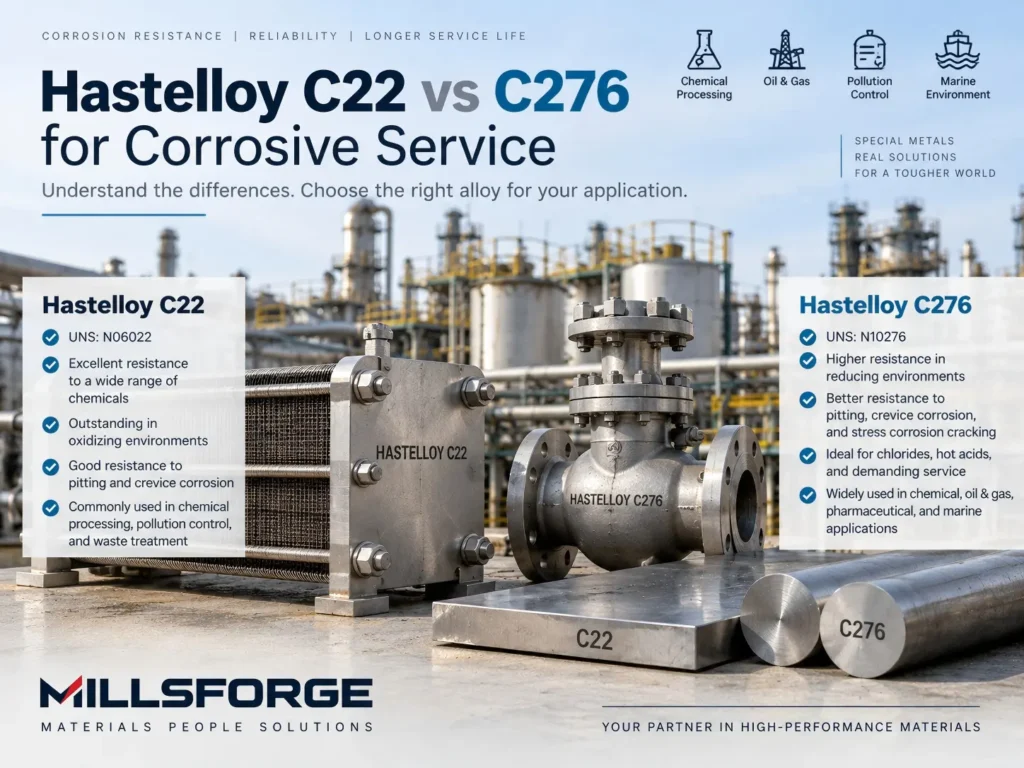
When equipment is exposed to highly corrosive chemicals, chlorides, acids, or mixed oxidizing and reducing environments, conventional stainless steels may not provide sufficient corrosion resistance. In these applications, nickel-chromium-molybdenum alloys such as Hastelloy C22 (UNS N06022) and Hastelloy C276 (UNS N10276) are commonly considered.
Both alloys offer excellent resistance to aggressive chemical environments, but they are not identical. The most important difference is the balance of chromium, molybdenum, and tungsten in their compositions, which affects their performance under different corrosion conditions.
This guide compares Hastelloy C22 and C276 and explains how to select between them for corrosive service.
C22 vs C276: Which Should You Choose?
Choose Hastelloy C22 when the application involves a particularly broad range of corrosive conditions, especially when strong oxidizing species may be present together with chlorides or reducing chemicals.
Typical reasons for selecting C22 include:
- High resistance to oxidizing media
- Excellent localized corrosion resistance
- Mixed oxidizing/reducing process chemistry
- Highly variable chemical environments
- Severe chloride-containing service
Choose Hastelloy C276 when proven performance in severe chemical processing environments is a priority, particularly in aggressive reducing or chloride-containing conditions.
Typical reasons for selecting C276 include:
- Severe reducing environments
- Hydrochloric-acid-containing processes
- Aggressive chloride service
- Long-established industry experience
- Existing equipment or specifications already standardized on C276
The correct question is therefore usually not:
“Is C22 better than C276?”
Instead, it should be:
“Which alloy provides the best corrosion resistance for the actual process chemistry, concentration, temperature, and equipment design?”
C22 vs C276 in Different Environments
| Service Environment | C22 | C276 | General Consideration |
| Oxidizing acids | Excellent | Very Good–Excellent | C22 often favored |
| Reducing acids | Excellent | Excellent | C276 has strong service history |
| Hydrochloric acid | Excellent | Excellent | Conditions determine selection |
| Sulfuric acid | Excellent | Excellent | Concentration and temperature critical |
| Chloride solutions | Excellent | Excellent | Both strong candidates |
| Mixed oxidizing/reducing media | Excellent | Excellent | C22 often attractive |
| Pitting environments | Excellent | Excellent | Verify actual conditions |
| Crevice corrosion | Excellent | Excellent | Both strong candidates |
| Chloride SCC | Excellent | Excellent | Both significantly outperform common stainless steels |
This table should be treated as a general engineering comparison rather than a corrosion-rate specification.
For critical applications, corrosion data for the exact chemical concentration and temperature should always be reviewed.
Quick Comparison: Hastelloy C22 vs C276
| Property | Hastelloy C22 | Hastelloy C276 |
| UNS Number | N06022 | N10276 |
| Alloy Type | Ni-Cr-Mo-W | Ni-Mo-Cr-W |
| Chromium | Higher, typically 20–22.5% | Typically 14.5–16.5% |
| Molybdenum | Typically 12.5–14.5% | Higher, typically 15–17% |
| Tungsten | Typically 2.5–3.5% | Typically 3–4.5% |
| Oxidizing Environments | Excellent | Very good |
| Reducing Environments | Excellent | Excellent |
| Pitting / Crevice Corrosion | Excellent | Excellent |
| Chloride SCC Resistance | Excellent | Excellent |
| Mixed Chemical Environments | Particularly strong | Excellent |
| Industry History | Extensive | Very extensive |
In simple terms:
C22 provides a particularly broad balance of corrosion resistance across both oxidizing and reducing environments, while C276 is a long-established alloy with exceptional resistance to severe reducing and chloride-containing conditions.
Neither alloy is universally better. Selection should be based on the actual chemical environment, concentration, temperature, contaminants, and fabrication requirements.
What Is Hastelloy C22?
Hastelloy C22 is a nickel-chromium-molybdenum-tungsten alloy designated UNS N06022.
Its relatively high chromium content provides strong resistance to oxidizing chemicals, while molybdenum and tungsten contribute resistance to reducing acids and localized corrosion.
C22 is especially useful when process conditions may vary or when equipment encounters multiple corrosive species.
Typical applications include:
- Chemical processing equipment
- Reactors and pressure vessels
- Heat exchangers
- Pharmaceutical processing
- Chlorination systems
- Flue gas treatment systems
- Pulp and paper equipment
- Waste treatment systems
- High-chloride process environments
One of the major advantages of C22 is its ability to tolerate environments containing both oxidizing and reducing species.
What Is Hastelloy C276?
Hastelloy C276 is a nickel-molybdenum-chromium-tungsten alloy designated UNS N10276.
It is one of the most widely used corrosion-resistant nickel alloys and has decades of service history in severe chemical processing environments.
Its high molybdenum content contributes to excellent resistance to localized corrosion and reducing acids, while chromium provides resistance to oxidizing conditions.
Typical applications include:
- Chemical reactors
- Acid processing systems
- Scrubbers
- Pollution-control equipment
- Heat exchangers
- Piping systems
- Sour and aggressive process environments
- Waste treatment equipment
- Pulp and paper processing
C276 is particularly well known for its resistance to severe chemical environments containing chlorides and reducing acids.
Chemical Composition Differences
The corrosion behavior of C22 and C276 is largely determined by their alloy chemistry.
Hastelloy C22
C22 contains a relatively high chromium level combined with significant molybdenum and tungsten.
The higher chromium content improves resistance to oxidizing environments.
Its approximate major alloying elements are:
- Nickel: Balance
- Chromium: 20–22.5%
- Molybdenum: 12.5–14.5%
- Tungsten: 2.5–3.5%
- Iron: approximately 2–6%
Hastelloy C276
C276 contains more molybdenum and tungsten but less chromium than C22.
Its approximate major alloying elements are:
- Nickel: Balance
- Chromium: 14.5–16.5%
- Molybdenum: 15–17%
- Tungsten: 3–4.5%
- Iron: approximately 4–7%
This difference helps explain their corrosion behavior.
More chromium favors resistance to oxidizing environments, while higher molybdenum content contributes strongly to resistance against reducing acids and localized corrosion.
Corrosion Resistance: C22 vs C276
1. Oxidizing Environments
This is one of the areas where C22 can have an advantage.
Because C22 contains considerably more chromium than C276, it generally provides excellent resistance to oxidizing media.
Examples may include environments involving:
- Nitric acid
- Ferric ions
- Cupric ions
- Oxidizing contaminants
- Certain chlorine-containing process streams
For applications where oxidizing conditions are important or where process chemistry fluctuates between oxidizing and reducing conditions, C22 is often an attractive choice.
2. Reducing Acids
Both alloys perform very well in reducing environments.
C276’s relatively high molybdenum content gives it particularly strong resistance to many reducing acids.
Applications involving hydrochloric acid are one reason C276 has historically been selected for severe chemical processing equipment.
C22 also offers excellent reducing-acid resistance, however, and the actual advantage depends heavily on acid concentration and temperature.
Therefore, material selection should not be made solely from the alloy designation.
3. Chloride-Induced Pitting
Chlorides can cause localized corrosion even when the overall corrosion rate of an alloy appears low.
Both C22 and C276 provide substantially greater resistance to chloride-induced pitting than conventional stainless steels such as 316L.
Their high nickel, molybdenum, chromium, and tungsten contents contribute to this performance.
For extremely aggressive chloride service, actual operating conditions should be evaluated, including:
chloride concentration + temperature + pH + oxidizing species + crevice geometry.
4. Crevice Corrosion
Crevice corrosion can occur under:
- Gaskets
- Flange faces
- Deposits
- Bolted connections
- Tube-to-tubesheet joints
- Other shielded surfaces
Both C22 and C276 have excellent resistance to crevice corrosion.
C22’s balanced Cr-Mo-W composition makes it particularly attractive for environments where both oxidizing chemicals and chlorides are present.
5. Chloride Stress Corrosion Cracking
Austenitic stainless steels can be vulnerable to chloride stress corrosion cracking at elevated temperatures.
The high nickel content of both C22 and C276 provides excellent resistance to chloride-induced stress corrosion cracking.
This makes these alloys useful for equipment exposed simultaneously to:
- Chlorides
- Elevated temperature
- Residual or applied tensile stresses
Fabrication and Welding
Both C22 and C276 can be fabricated using conventional techniques used for nickel alloys.
Common product forms include:
Plate / Sheet Bar / Pipe / Tube / Forgings / Flanges / Fittings / Rings / Machined components
Both alloys can also be welded using appropriate nickel-alloy welding procedures and filler metals.
Heat input, interpass temperature, surface cleanliness, filler selection, and welding procedure qualification should be properly controlled.
For pressure equipment or regulated applications, material and welding requirements should be reviewed against the applicable ASME, ASTM, EN, or project specification.
Can C22 Replace C276?
Sometimes, but substitution should not be automatic.
Although the two alloys have overlapping applications, they have different chemical compositions and may be specified under different material standards, product specifications, approved material lists, or engineering requirements.
Before replacing C276 with C22—or vice versa—verify:
- Design code
- ASTM/ASME material specification
- Operating temperature
- Chemical composition of the process fluid
- Acid concentration
- Chloride concentration
- Oxidizing contaminants
- Required corrosion allowance
- Welding requirements
- Customer or end-user approval
For regulated equipment, changing the alloy grade may require formal engineering approval.
Common Product Forms
Both alloys are available in a wide range of industrial forms.
Typical examples include:
Hastelloy C22 / UNS N06022
Plate · Sheet · Bar · Pipe · Tube · Forgings · Rings · Flanges · Fittings · Machined Components
Hastelloy C276 / UNS N10276
Plate · Sheet · Bar · Pipe · Tube · Forgings · Rings · Flanges · Fittings · Machined Components
For drawing-based components, material can also be supplied as forged or machined parts with dimensional inspection, PMI, NDT, and material certification as required.
Material Certification and Inspection
For critical corrosion-resistant alloy components, material traceability is just as important as alloy selection.
Depending on the project specification, documentation may include:
- EN 10204 3.1 material certificate
- Chemical composition
- Mechanical properties
- Heat number traceability
- Positive Material Identification (PMI)
- Dimensional inspection
- Ultrasonic testing
- Liquid penetrant testing
- Third-party inspection
Additional testing can be arranged according to the applicable material specification or project requirements.
Conclusion
Hastelloy C22 and C276 are both high-performance nickel alloys designed for some of the most demanding corrosive environments.
The key difference lies in their alloy balance:
C22’s higher chromium content provides particularly strong resistance to oxidizing and mixed chemical environments, while C276’s higher molybdenum content and extensive service history make it a proven choice for severe reducing and chloride-containing applications.
For critical applications, selection should be based on actual process conditions rather than alloy reputation alone.
MillsForge supplies Hastelloy C22 (UNS N06022) and Hastelloy C276 (UNS N10276) materials and custom components in forms including bars, plates, pipes, tubes, forgings, rings, flanges, fittings, and drawing-based machined parts.
Material traceability, EN 10204 3.1 certification, PMI, dimensional inspection, NDT, and third-party inspection can be provided according to project requirements.
FAQ
Not universally. C22 has higher chromium and provides an excellent balance of resistance to oxidizing and reducing environments. C276 contains more molybdenum and has an extensive history in severe reducing and chloride-containing environments. The better alloy depends on the service conditions.
Both can provide excellent resistance to hydrochloric acid. C276 is particularly well known for this application, but concentration, temperature, aeration, contaminants, and process conditions must be considered before selecting an alloy.
Both C22 and C276 provide excellent resistance to chloride-induced pitting, crevice corrosion, and stress corrosion cracking compared with conventional stainless steels. The preferred material depends on temperature, chloride concentration, pH, and other chemicals present.
Hastelloy C22 is designated UNS N06022.
Hastelloy C276 is designated UNS N10276.
Yes. Both alloys can be welded using appropriate nickel-alloy welding procedures. Welding consumables and procedures should be selected according to the base material, service conditions, design code, and project requirements.
Pricing varies with product form, dimensions, quantity, mill availability, raw-material costs, and certification requirements. Material price alone should not determine alloy selection for critical corrosive service.