Duplex 2205 and Super Duplex 2507 are two of the most widely used duplex stainless steels for chemical processing, oil and gas, seawater, desalination and other corrosive applications.
Both combine austenitic and ferritic microstructures, providing higher strength and better resistance to chloride stress corrosion cracking than conventional austenitic stainless steels such as 304L and 316L.
However, Duplex 2205 and Super Duplex 2507 are not interchangeable grades.
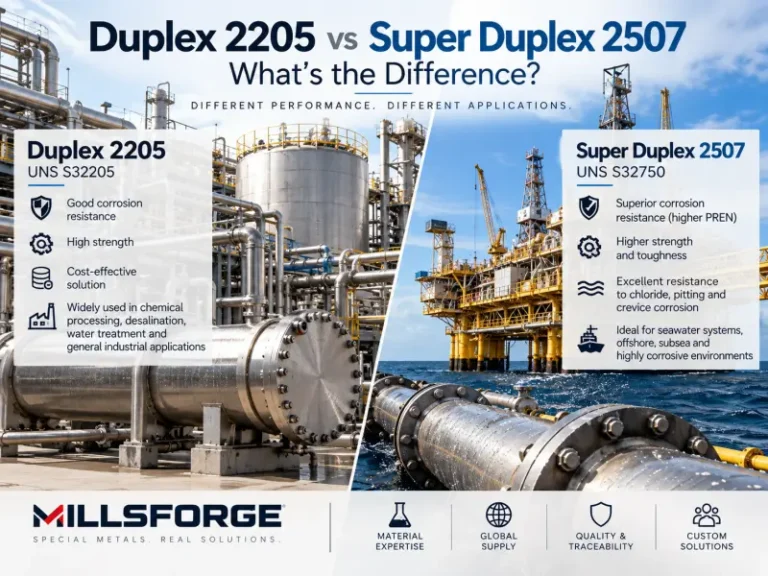
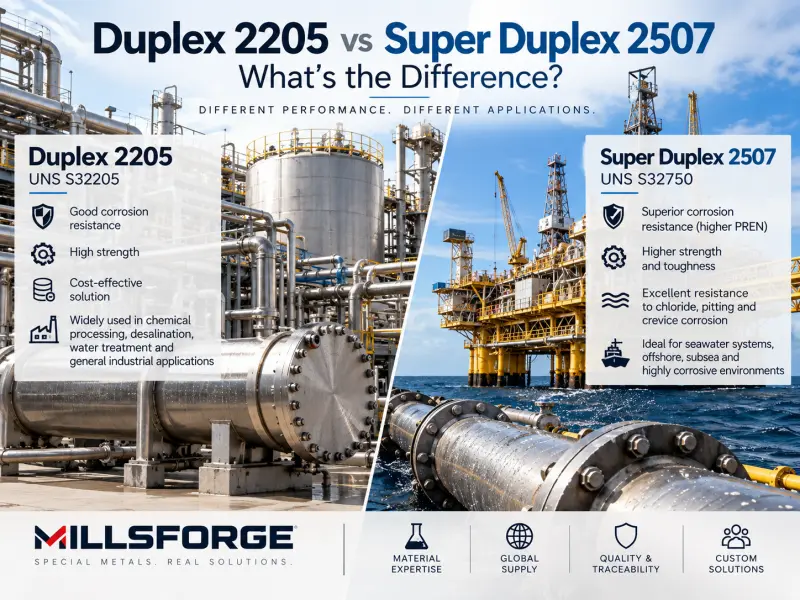
The main difference is alloy content. Super Duplex 2507 contains higher levels of chromium, molybdenum and nitrogen, resulting in significantly greater resistance to pitting and crevice corrosion, particularly in aggressive chloride-containing environments. It also provides higher mechanical strength.
For many industrial applications, 2205 provides an effective balance between corrosion resistance, strength and cost. When chloride concentration, temperature or overall corrosivity becomes more severe, 2507 may be the more appropriate material.
Duplex 2205 vs 2507: Which Should You Choose?
A practical material-selection framework looks like this:
| Requirement | 2205 | 2507 |
| General industrial corrosion | ✓ | ✓ |
| Moderate chloride service | ✓ | ✓ |
| High chloride concentration | Consider | Strong candidate |
| Seawater service | Evaluate carefully | Common choice |
| High pitting resistance | Good | Excellent |
| PREN >40 required | ✕ | ✓ |
| Higher mechanical strength | Good | Better |
| Lower material cost | Usually favorable | Higher alloy content |
| Offshore / subsea | Application dependent | Commonly specified |
| ASTM A182 F51 required | ✓ | ✕ |
| ASTM A182 F53 required | ✕ | ✓ |
The important point is not that 2507 is always the better material.
If Duplex 2205 provides adequate corrosion resistance and mechanical properties for the design conditions, moving to 2507 may add unnecessary alloy cost and fabrication requirements.
Conversely, selecting 2205 purely to reduce material cost can be a poor decision if the service environment requires the additional localized corrosion resistance of 2507.
Duplex 2205 vs Super Duplex 2507 at a Glance
| Property | Duplex 2205 | Super Duplex 2507 |
| Common UNS grade | S32205 / S31803 | S32750 |
| EN Number | 1.4462 | 1.441 |
| Typical Cr | ~22% | ~25% |
| Typical Ni | ~5–5.5% | ~7% |
| Typical Mo | ~3.2% | ~4% |
| Typical N | ~0.18% | ~0.30% |
| Typical PREN | ~35 | >40 |
| ASTM A182 forging grade | F51 | F53 |
| Strength | High | Higher |
| Chloride resistance | Very good | Excellent |
| Typical environment | Moderate-to-severe corrosive service | Severe chloride/corrosive service |
Representative compositions vary within the applicable product specification and manufacturer chemistry. Alleima, for example, lists nominal compositions around 22Cr-5Ni-3.2Mo-0.18N for SAF 2205 and 25Cr-7Ni-4Mo-0.3N for SAF 2507.
What Is Duplex 2205?
Duplex 2205 is a 22% chromium duplex stainless steel and one of the most commonly used duplex grades.
The designation “2205” comes approximately from its chromium and nickel content:
22% Cr + 5% Ni
with additional molybdenum and nitrogen contributing to corrosion resistance and mechanical properties.
Common designations include:
UNS S32205 / S31803
EN 1.4462
X2CrNiMoN22-5-3
For ASTM A182 forged products such as flanges and forged fittings, Duplex 2205 is commonly associated with Grade F51.
Duplex 2205 offers high resistance to general corrosion, pitting, crevice corrosion and chloride stress corrosion cracking. Its proof strength is roughly twice that of conventional austenitic stainless steels, according to Alleima’s material data.
Typical applications include chemical processing equipment, pressure vessels, heat exchangers, pulp and paper equipment, oil and gas systems, water treatment and chloride-containing process environments.
What Is Super Duplex 2507?
Super Duplex 2507 is a more highly alloyed duplex stainless steel designed for more aggressive corrosive environments.
Its common designation is:
UNS S32750
EN 1.4410
X2CrNiMoN25-7-4
For ASTM A182 forged products, the corresponding grade is commonly F53. Alleima
The name “2507” reflects its approximate composition of:
25% Cr + 7% Ni
together with approximately 4% Mo and 0.3% N.
This higher Cr-Mo-N alloy content provides substantially greater resistance to localized corrosion in aggressive chloride environments. Alleima identifies S32750 as suitable for highly corrosive conditions, including seawater cooling, desalination, oil and gas, geothermal wells, refineries and petrochemical applications.
Chemical Composition: Why 2507 Performs Differently
The chemistry explains much of the performance difference between the two materials.
| Element | Duplex 2205 | Super Duplex 2507 | Effect |
| Chromium | ~22% | ~25% | General and localized corrosion resistance |
| Nickel | ~5–5.5% | ~7% | Austenite stability |
| Molybdenum | ~3.2% | ~4% | Pitting and crevice corrosion resistance |
| Nitrogen | ~0.18% | ~0.30% | Pitting resistance and strength |
Representative manufacturer chemistry shown; actual acceptance limits must follow the applicable UNS/ASTM/EN product specification.
The important point is that 2507 contains more chromium, molybdenum and nitrogen.
That difference becomes particularly important when the material is exposed to chlorides.
PREN: One of the Biggest Differences
When comparing duplex stainless steels, one of the most useful indicators is the Pitting Resistance Equivalent Number (PREN).
A commonly used equation is:
PREN = %Cr + 3.3 × %Mo + 16 × %N
PREN provides a comparative indication of resistance to localized pitting corrosion, particularly in chloride-containing environments.
Representative values are:
Duplex 2205: PREN ≈ 35
Super Duplex 2507: PREN > 40
Alleima reports a PRE above 35 for its optimized 2205 chemistry, while its S32750 tubing has a minimum PRE of 42.5.
This difference is one of the reasons 2507 is categorized as super duplex rather than standard duplex.
Why does PREN matter?
As chloride concentration and temperature increase, the risk of localized attack generally increases.
Higher PREN does not by itself guarantee suitability for a particular service condition, but it is an important screening parameter when comparing stainless steels.
Actual performance also depends on factors such as:
temperature, chloride concentration, pH, oxidizing conditions, crevices, deposits, welding, surface condition and fabrication quality.
Corrosion Resistance
This is where the difference between 2205 and 2507 becomes most important.
Duplex 2205
2205 provides very good resistance to:
- General corrosion
- Chloride stress corrosion cracking
- Pitting
- Crevice corrosion
- Erosion corrosion
- Corrosion fatigue
It offers considerably better chloride performance than conventional 304 and 316 stainless steels in many environments.
Super Duplex 2507
2507 takes localized corrosion resistance considerably further.
It provides excellent resistance to:
- Chloride-induced pitting
- Crevice corrosion
- Chloride stress corrosion cracking
- Erosion corrosion
- Corrosion fatigue
- Many aggressive process environments
Its higher PREN makes it particularly attractive for seawater, high-chloride brines and demanding offshore environments.
What About Seawater?
This is one of the most practical differences between the two grades.
Duplex 2205 can perform very well in many chloride-containing applications. However, warm natural seawater and environments where crevices, deposits or stagnant conditions occur can be significantly more demanding.
Super Duplex 2507 was specifically developed for aggressive chloride-containing service and is widely used for seawater cooling, desalination and offshore applications.
Therefore, engineers evaluating materials for:
seawater piping, offshore platforms, subsea equipment, desalination systems or high-chloride cooling water
often evaluate 2507 when 2205 does not provide sufficient corrosion margin.
The final choice should always be based on the actual operating environment rather than simply choosing the material with the higher PREN.
Mechanical Strength
Both grades offer substantially higher strength than conventional austenitic stainless steels.
2507, however, generally provides higher minimum strength than 2205.
As one representative comparison for solution-annealed tubing, Alleima lists:
| Property | SAF 2205 | SAF 2507 |
| Yield Strength | 485 MPa | 550 MPa |
| Tensile Strength | 680 MPa | 800 MPa |
| Elongation | 25% | 25% |
These values are manufacturer/product-form data and should not replace the mechanical requirements of the applicable ASTM, ASME or EN specification.
Higher strength can potentially allow reduced wall thickness or component weight in appropriately designed systems, although this must be determined according to the applicable design code.
F51 vs F53: Important for Flanges and Forgings
For purchasers of flanges, forged fittings, rings and other forged components, another common comparison is:
ASTM A182 F51 vs F53
Generally:
F51 → Duplex 2205 / UNS S31803 or S32205 family
F53 → Super Duplex 2507 / UNS S32750
Alleima identifies its 2205 billet as suitable for producing ASTM A182 F51 forgings, while its S32750 billet is suitable for ASTM A182 F53.
Therefore, a typical flange specification might read: ASTM A182 F51, ASME B16.5, EN 10204 3.1
or: ASTM A182 F53 / UNS S32750, ASME B16.5, EN 10204 3.1
The two should not automatically be substituted for one another merely because both are duplex stainless steels.
Welding and Fabrication
Both 2205 and 2507 have good weldability when suitable welding procedures are followed.
However, duplex stainless steel welding requires careful control of:
heat input, interpass temperature, filler metal, shielding gas, cooling conditions and phase balance.
The goal is to maintain an appropriate balance between ferrite and austenite while avoiding detrimental intermetallic phases.
This becomes especially important with Super Duplex 2507 because poor welding or heat treatment can reduce the corrosion performance expected from the higher-alloy material.
In critical offshore and oil & gas projects, the material specification may therefore require additional controls such as:
ferrite testing, PMI, ASTM G48 corrosion testing, impact testing, NDE and qualified welding procedures.
The applicable project specification should define the required tests and acceptance criteria.
Typical Applications
Duplex 2205
2205 is commonly considered for:
Chemical processing equipment, pressure vessels, heat exchangers, pulp and paper equipment, water treatment systems, oil and gas equipment, process piping and moderately aggressive chloride service. Alleima also lists refinery and chloride-contaminated process environments among its applications.
Super Duplex 2507
2507 is particularly suited to:
Offshore oil and gas, seawater cooling, desalination, salt evaporation, geothermal wells, refineries, petrochemical equipment and mechanical components requiring both high strength and high corrosion resistance.
Product Forms and Applicable Standards
Both alloys are available in a wide range of industrial product forms.
Common specifications include:
| Product | Common Standard |
| Plate / Sheet | ASTM A240 |
| Seamless / Welded Pipe | ASTM A790 |
| Tube | ASTM A789 |
| Forged Flanges | ASTM A182 |
| Forged Fittings | ASTM A182 |
| Butt-Weld Fittings | ASTM A815 |
| Bar | ASTM A276 / A479 |
Alleima lists these product standards for 2205 and similar product standards for S32750, depending on the supplied form.
A purchase specification should therefore not simply state: Super Duplex 2507
A more useful requirement would be something such as: ASTM A182 F53 / UNS S32750, ASME B16.5, solution annealed, EN 10204 3.1, PMI and corrosion testing as specified.
This gives the manufacturer much clearer technical and documentation requirements.
Conclusion
The fundamental difference between Duplex 2205 and Super Duplex 2507 is the level of alloying and the resulting corrosion resistance.
Duplex 2205 offers an effective combination of strength, corrosion resistance and economy for a broad range of industrial applications.
Super Duplex 2507 increases chromium, molybdenum and nitrogen content, raising PREN above 40 and providing greater resistance to pitting and crevice corrosion in aggressive chloride-containing environments. This makes it particularly valuable for seawater, offshore, subsea, desalination and other severe corrosive services.
Material selection should ultimately consider the complete operating environment, applicable design code, product standard, fabrication route and project-specific testing requirements.
FAQ
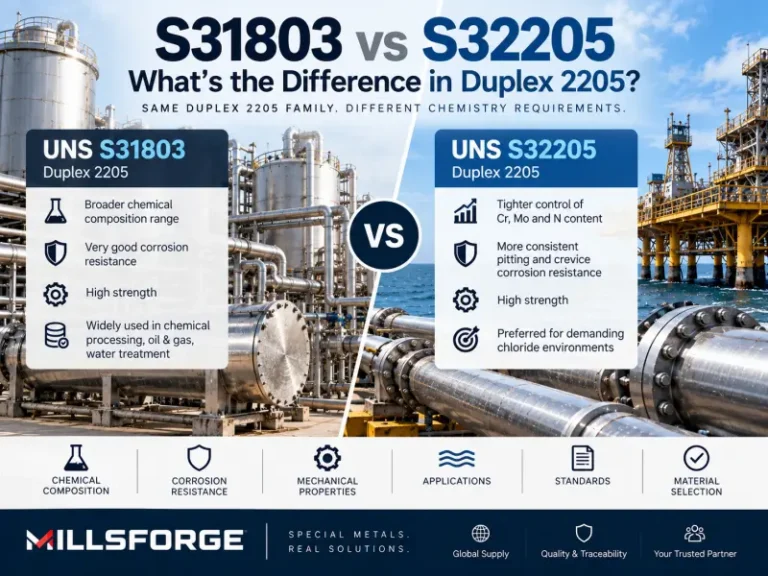
2205 commonly refers to the duplex stainless steel family represented by UNS S31803 and S32205. Modern 2205 products are frequently produced to the tighter S32205 chemistry, particularly with controlled Mo and N levels to ensure corrosion performance.
Yes. UNS S32750 is commonly known as Super Duplex 2507 and corresponds to EN 1.4410.
2507 contains higher levels of chromium, molybdenum and nitrogen. This gives it higher strength and, most importantly, greater resistance to pitting and crevice corrosion in aggressive chloride environments.
Using the common formula PREN = Cr + 3.3Mo + 16N, optimized 2205 chemistry is typically around or above 35, while 2507 is above 40. Specific values depend on actual chemistry; Alleima reports >35 for SAF 2205 and >42.5 for SAF 2507 tubing.
ASTM A182 F51 is commonly associated with 2205 duplex stainless steel forgings.
ASTM A182 F53 corresponds to UNS S32750 for super duplex forged products.
Not automatically. The substitution should be reviewed against corrosion conditions, design requirements, applicable standards and the project specification. Where F53/S32750 or a minimum PREN above 40 is explicitly required, ordinary 2205/F51 would not satisfy that material requirement.