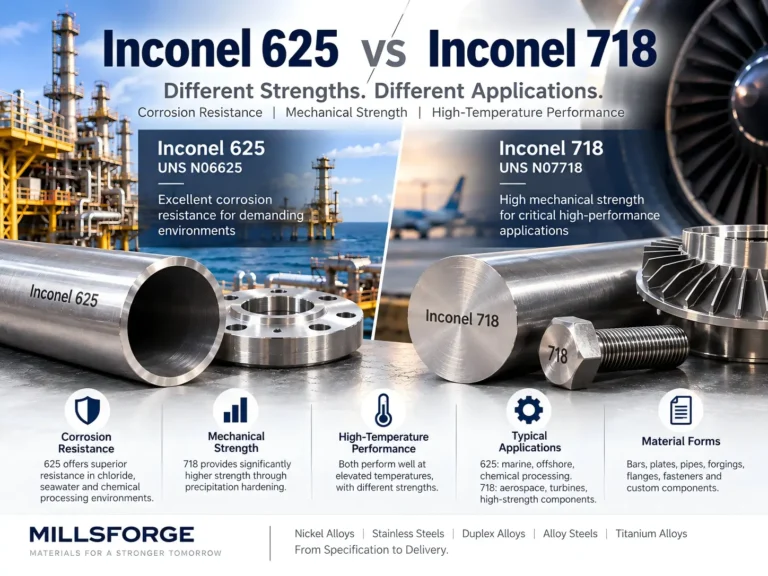
Inconel 625 and Inconel 718 are two widely used nickel-based superalloys, but they are designed around different engineering priorities.
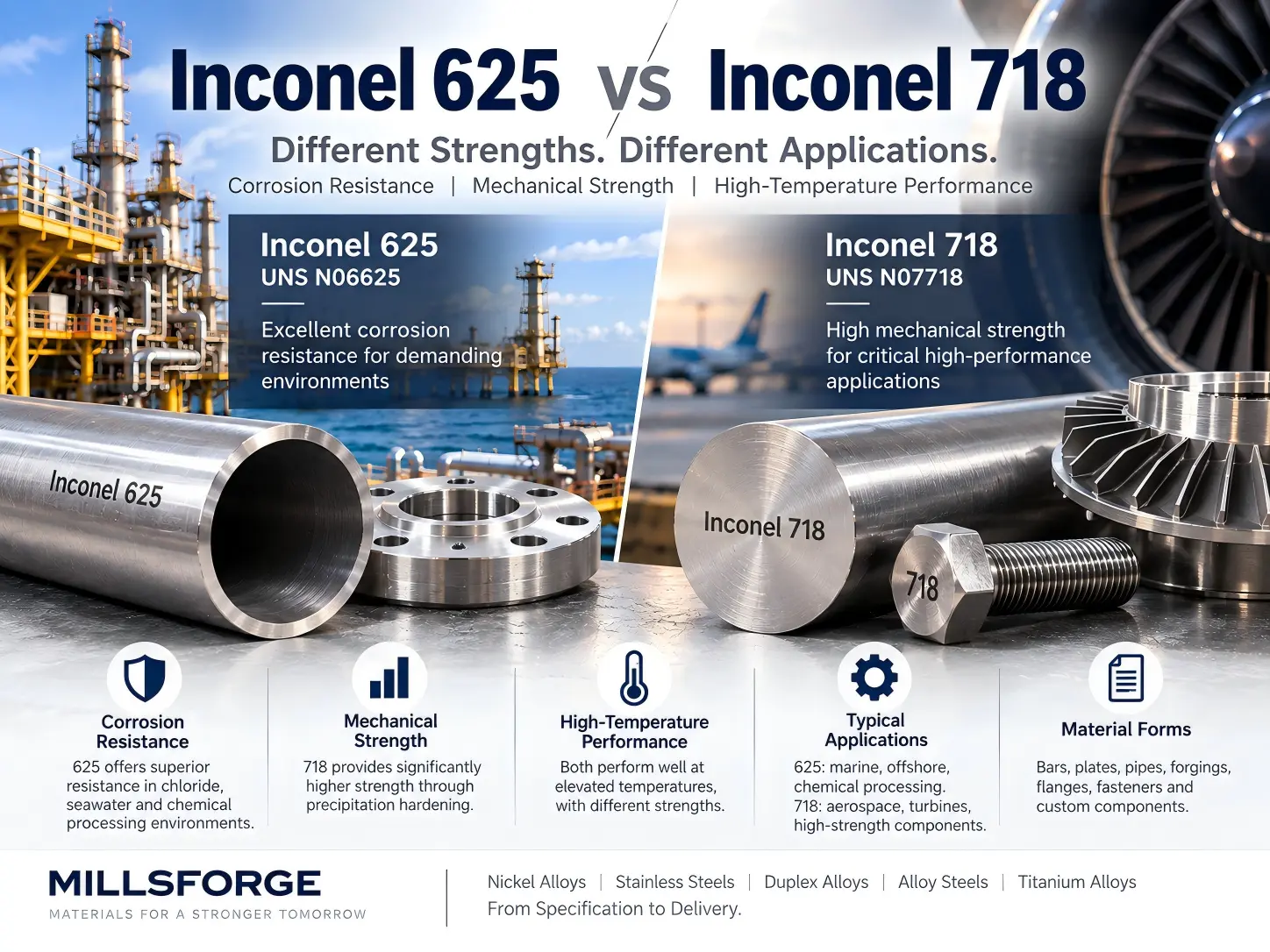
Inconel 625 (UNS N06625) is a nickel-chromium-molybdenum-niobium alloy known for excellent corrosion resistance, particularly in seawater, chloride-containing environments, and chemical processing applications.
Inconel 718 (UNS N07718) is a precipitation-hardenable nickel-chromium alloy developed primarily for high mechanical strength, fatigue resistance, and elevated-temperature performance.
In simple terms:
Inconel 625 is generally selected when corrosion resistance is the primary concern, while Inconel 718 is commonly selected when very high mechanical strength is required.
However, alloy selection should always consider temperature, corrosion environment, heat-treatment condition, mechanical loading, fabrication requirements, and the applicable material specification.
Quick Comparison: Inconel 625 vs 718
| Property | Inconel 625 | Inconel 718 |
| UNS Number | N06625 | N07718 |
| Alloy Type | Ni-Cr-Mo-Nb | Ni-Cr-Fe-Nb-Mo-Ti-Al |
| Nickel | ≥58% | 50–55% |
| Chromium | 20–23% | 17–21% |
| Molybdenum | 8–10% | 2.8–3.3% |
| Nb + Ta | 3.15–4.15% | 4.75–5.50% |
| Strengthening Mechanism | Primarily solid-solution strengthening | Precipitation hardening |
| Corrosion Resistance | Excellent | Very Good |
| Seawater Resistance | Excellent | Good, application dependent |
| Pitting / Crevice Resistance | Excellent | Lower than 625 in many aggressive chloride environments |
| Mechanical Strength | High | Very High |
| Fatigue Resistance | Good | Excellent |
| Typical Focus | Corrosion + strength | High strength + fatigue |
| Common Industries | Marine, offshore, chemical processing | Aerospace, turbines, high-strength components |
Which Should You Choose?
Consider Inconel 625 when the application prioritizes:
- Corrosion resistance
- Seawater resistance
- Chloride resistance
- Pitting and crevice-corrosion resistance
- Marine/offshore service
- Chemical processing
- Combination of corrosion resistance and good strength
Consider Inconel 718 when the application prioritizes:
- Very high mechanical strength
- High yield strength
- Fatigue resistance
- High-strength fasteners
- Turbine components
- Aerospace components
- Highly loaded mechanical components
The correct material should therefore be selected according to the actual engineering requirement rather than simply comparing which alloy has the higher strength or alloy number.
Inconel 625 vs 718 Applications
| Application | General Consideration |
| Seawater piping | 625 widely used |
| Offshore equipment | 625 widely used |
| Chemical processing | 625 often attractive |
| Aggressive chlorides | 625 generally offers stronger localized-corrosion resistance |
| Bellows / Expansion Joints | 625 commonly used |
| Aerospace engine components | 718 widely used |
| Turbine components | 718 widely used |
| High-strength fasteners | 718 commonly used |
| Highly loaded shafts | 718 often considered |
| Very high mechanical strength | 718 has a major advantage |
What Is Inconel 625?
Inconel 625, designated UNS N06625, contains substantial chromium, molybdenum, and niobium.
Molybdenum contributes strongly to resistance against localized corrosion, while molybdenum and niobium strengthen the nickel-chromium matrix.
One important feature of Alloy 625 is that it can achieve high strength without relying primarily on a precipitation-hardening heat treatment.
Typical applications include:
- Seawater piping
- Offshore equipment
- Marine components
- Chemical processing
- Heat exchangers
- Bellows
- Expansion joints
- Pollution-control equipment
- Aggressive chloride service
This combination of corrosion resistance and mechanical properties makes Alloy 625 particularly useful where equipment must withstand both corrosive fluids and mechanical loading.
What Is Inconel 718?
Inconel 718, designated UNS N07718, is a precipitation-hardenable nickel-based superalloy.
Unlike Alloy 625, its exceptional strength depends strongly on its microstructure and heat-treatment condition.
Niobium, titanium, and aluminum contribute to the formation of strengthening precipitates during heat treatment.
This allows Alloy 718 to retain high strength over a wide temperature range.
Typical applications include:
- Gas turbine components
- Aircraft engine components
- High-strength fasteners
- Shafts
- Aerospace components
- Springs
- High-pressure components
- Energy-industry components
- High-temperature mechanical components
Chemical Composition Differences
The difference between the two alloys becomes clearer when their alloying systems are compared.
Inconel 625:
Ni + Cr + high Mo + Nb
Inconel 718:
Ni + Cr + Fe + Nb + Mo + Ti + Al
Alloy 625 contains substantially more molybdenum, which is one reason for its excellent localized-corrosion resistance.
Alloy 718 contains titanium and aluminum in addition to niobium, enabling precipitation hardening.
This leads to one of the most important distinctions between the alloys:
625 is designed around corrosion resistance combined with solid-solution strength.
718 is designed around precipitation-strengthened mechanical performance.
Corrosion Resistance: 625 vs 718
Both alloys are corrosion resistant, but they should not be considered equivalent.
Chloride Environments
Alloy 625 generally has an important advantage in aggressive chloride environments.
Its high molybdenum content provides strong resistance to:
- Pitting
- Crevice corrosion
- Seawater
- Chloride-containing process fluids
This is one reason Alloy 625 is widely encountered in marine and offshore applications.
Seawater
For seawater exposure, Alloy 625 has a particularly strong service history.
It is used in applications such as seawater piping, marine equipment, offshore components, bellows, and other equipment exposed to chloride-rich environments.
Alloy 718 may be used in marine-related applications where its mechanical properties are required, but it should not automatically be considered a corrosion-equivalent substitute for Alloy 625.
Chemical Processing
For severe chemical-processing environments, Alloy 625 is often attractive because of its combination of chromium and relatively high molybdenum.
However, actual corrosion performance depends on:
chemical species + concentration + temperature + pH + contaminants + aeration + equipment geometry.
Material selection should therefore be based on corrosion data for the actual process conditions.
Mechanical Strength: 625 vs 718
This is where Alloy 718 becomes particularly important.
In appropriate heat-treated conditions, Alloy 718 can achieve substantially higher tensile and yield strength than Alloy 625.
This makes it especially suitable for highly loaded components such as:
- Bolts
- Fasteners
- Shafts
- Turbine components
- Aircraft engine parts
- High-pressure components
Therefore, if the primary engineering requirement is maximum mechanical strength rather than maximum corrosion resistance, Alloy 718 may be considered.
Heat Treatment: A Major Difference
The role of heat treatment is much more important for Alloy 718.
Inconel 718 is commonly solution treated and subsequently age hardened to develop its required mechanical properties.
The precipitation of strengthening phases gives the alloy its characteristic high strength.
This means that when purchasing Alloy 718, simply specifying:
Inconel 718 / UNS N07718
may not be sufficient.
The buyer should also verify:
- Product specification
- Heat-treatment condition
- Required mechanical properties
- Applicable ASTM/ASME specification
- Hardness requirements
- Testing requirements
For critical 718 components, heat-treatment condition is an essential part of the material specification.
High-Temperature Performance
Both alloys can operate at elevated temperatures, but their engineering roles differ.
Alloy 625 provides a combination of:
corrosion resistance + oxidation resistance + strength
while Alloy 718 is especially valued for:
high strength + fatigue resistance + creep/stress-rupture performance within its intended temperature range.
This is why Alloy 718 is so widely used in aerospace engines and turbine components.
Can Inconel 718 Replace Inconel 625?
Not automatically.
This is especially important because someone looking only at mechanical properties might conclude that 718 is simply a stronger version of 625.
It is not.
Although Alloy 718 can provide much higher strength, Alloy 625 generally provides superior resistance to many aggressive chloride and localized-corrosion environments.
Similarly, replacing 718 with 625 may result in insufficient mechanical strength for a component originally designed around age-hardened Alloy 718 properties.
Before substitution, evaluate:
- Design stress
- Yield and tensile requirements
- Fatigue loading
- Operating temperature
- Corrosion environment
- Chloride concentration
- Heat-treatment condition
- ASTM/ASME specification
- Welding requirements
- Customer/end-user approval
Conclusion
Inconel 625 and Inconel 718 are both high-performance nickel alloys, but they solve different engineering problems.
Inconel 625 (UNS N06625) is particularly valued for its combination of corrosion resistance, seawater performance, resistance to localized corrosion, and good mechanical strength.
Inconel 718 (UNS N07718) is a precipitation-hardenable superalloy designed to provide exceptionally high mechanical strength, fatigue resistance, and elevated-temperature performance.
For procurement and material substitution, the distinction is critical:
625 is primarily a corrosion-resistant alloy with high strength; 718 is primarily a high-strength superalloy with good corrosion resistance.
Material selection should consider corrosion environment, mechanical loading, operating temperature, heat-treatment condition, fabrication requirements, applicable specification, and end-user approval.
MillsForge supplies Alloy 625 and Alloy 718 in bars, plates, forgings, rings, shafts, fasteners, flanges, and drawing-based machined components, with material traceability, EN 10204 certification, PMI, NDT, mechanical testing, and third-party inspection available according to project requirements.
FAQ
Yes, in appropriate age-hardened conditions, Alloy 718 can achieve substantially higher mechanical strength than Alloy 625.
For many aggressive chloride, seawater, pitting, and crevice-corrosion environments, Alloy 625 generally offers stronger localized-corrosion resistance due in large part to its higher molybdenum content.
Alloy 625 is widely used for seawater and marine applications because of its excellent resistance to chloride-induced localized corrosion.
Alloy 718 is precipitation hardenable. Niobium, titanium, and aluminum enable the formation of strengthening precipitates during controlled heat treatment.
Inconel 625 is UNS N06625.
Inconel 718 is UNS N07718.
Both alloys are weldable using appropriate procedures. However, Alloy 718 requires particular attention to welding and subsequent heat-treatment requirements when specific mechanical properties are required.