S32750 vs S32760: What’s the Difference?
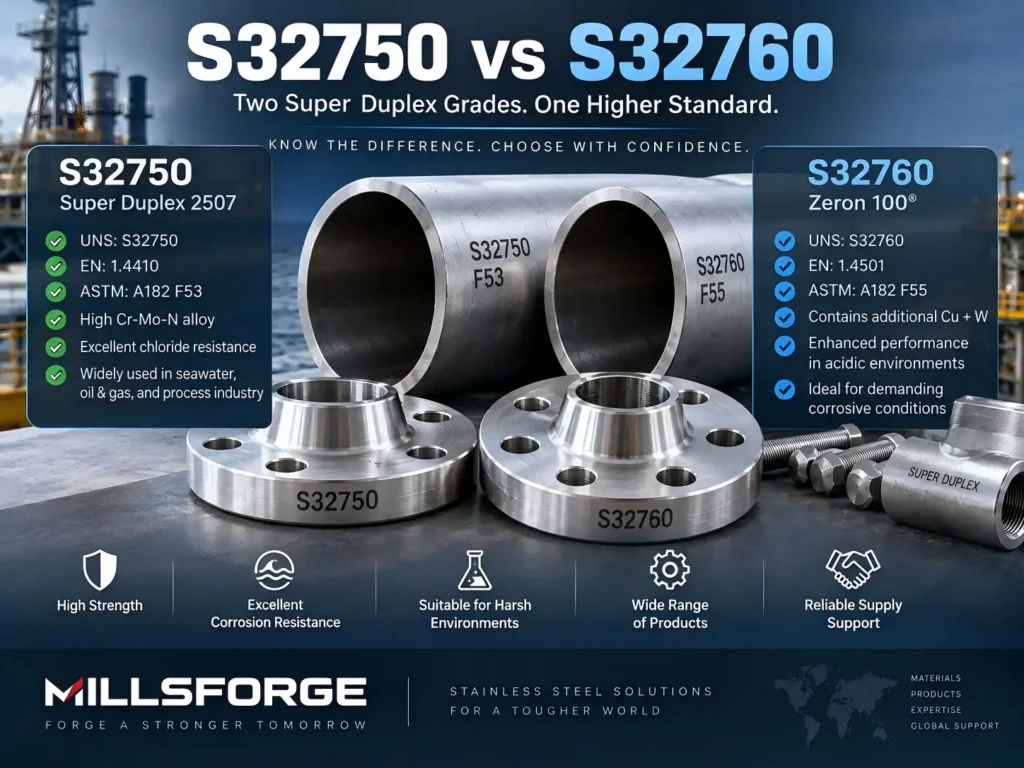
UNS S32750 and UNS S32760 are two widely used super duplex stainless steels designed for demanding environments involving chlorides, seawater, high pressure, and corrosive process fluids.
At first glance, the two grades appear very similar. Both contain approximately 25% chromium, have a duplex ferritic-austenitic microstructure, provide high mechanical strength, and typically achieve a PREN above 40.
The main difference is in their alloying chemistry:
S32760 contains intentional additions of copper (Cu) and tungsten (W), while S32750 does not.
These additions can influence corrosion performance, particularly in certain acidic and aggressive environments.
Which Grade Should You Choose?
A useful practical rule is:
| Service condition | Typical preference |
| Seawater | S32750 or S32760 |
| High-chloride brine | S32750 or S32760 |
| Offshore piping | Project specification dependent |
| Desalination | Often S32750 |
| Heat exchangers | Application dependent |
| Chemical processing | S32750 or S32760 |
| Reducing acidic environments | Consider S32760 |
| Project specifies F53 | S32750 |
| Project specifies F55 | S32760 |
| Project specifies Zeron 100庐 | Verify S32760/Zeron requirements |
The governing project specification should always take precedence over a general material comparison.
S32750 vs S32760 at a Glance
| Property | UNS S32750 | UNS S32760 |
| Common designation | Super Duplex 2507 | Super Duplex S32760 / Zeron 100® |
| EN number | 1.441 | 1.4501 |
| ASTM forging grade | F53 | F55 |
| Chromium (Cr) | 24–26% | 24–26% |
| Nickel (Ni) | 6–8% | 6–8% |
| Molybdenum (Mo) | 3–5% | 3–4% |
| Nitrogen (N) | 0.24–0.32% | 0.20–0.30% |
| Copper (Cu) | No intentional addition / limited | 0.50–1.00% |
| Tungsten (W) | No intentional addition | 0.50–1.00% |
| PREN | Typically >40 | Typically >40 |
| Typical strength level | Very high | Very high |
| Key advantage | Excellent chloride/seawater resistance | Additional performance in certain acidic environments |
The exact permitted chemistry depends on the applicable material/product specification, so purchase orders should reference the required UNS designation together with the relevant ASTM, ASME or EN standard.
What Is UNS S32750?
UNS S32750 is one of the most commonly specified super duplex stainless steels and is widely known as 2507.
Its corrosion resistance comes primarily from its high levels of:
Chromium + Molybdenum + Nitrogen
A typical chemistry is approximately:
25Cr – 7Ni – 4Mo – 0.3N
This combination provides excellent resistance to pitting, crevice corrosion and chloride stress corrosion cracking, while maintaining the high strength characteristic of duplex stainless steels.
For forgings and flanges manufactured to ASTM A182, S32750 is commonly specified as:
ASTM A182 F53
Its EN designation is:
EN 1.4410 / X2CrNiMoN25-7-4.
Typical applications include seawater systems, offshore equipment, oil and gas components, pressure equipment, heat exchangers, piping, flanges, valves, fasteners and other chloride-service components.
What Is UNS S32760?
UNS S32760 is another 25% chromium super duplex stainless steel.
It is commonly associated with Zeron 100®, although S32760 is the generic UNS designation.
Its EN designation is:
EN 1.4501
For ASTM A182 forgings:
ASTM A182 F55
The important difference is that S32760 intentionally contains approximately:
0.5–1.0% Cu + 0.5–1.0% W
in addition to chromium, nickel, molybdenum and nitrogen.
These additions distinguish S32760 from S32750 and can provide advantages in particular corrosive environments.
The Biggest Difference: Copper and Tungsten
This is the most important point for engineers and purchasers.
S32750
The corrosion-resistant alloying system is primarily:
Cr + Mo + N
S32760
The alloying system additionally incorporates:
Cr + Mo + N + Cu + W
Copper can improve performance in certain reducing acidic environments, while tungsten contributes to localized corrosion resistance and is included in some PREN/PREW calculations. Manufacturer data for Zeron 100 specifically highlights improved resistance in acid environments such as sulfuric and hydrochloric acid compared with conventional 2507-type super duplex.
This does not, however, mean that S32760 is universally “better” than S32750. Material selection still depends on the actual process environment, temperature, chloride concentration, acidity, fabrication route and governing project specification.
Corrosion Resistance
Both S32750 and S32760 provide very high resistance to localized corrosion.
A common simplified PREN equation is:
PREN = %Cr + 3.3 × %Mo + 16 × %N
For tungsten-bearing alloys, an adjusted expression may be used:
PREN(W) = %Cr + 3.3 × (%Mo + 0.5 × %W) + 16 × %N
Both alloys generally fall into the PREN >40 super duplex range.
For seawater and chloride environments, both grades can therefore provide excellent performance when correctly processed, heat treated and fabricated.
The distinction becomes more important when the environment also contains aggressive acidic or reducing conditions.
Mechanical Properties
From a practical engineering perspective, S32750 and S32760 belong to a similar strength class.
Their duplex microstructure gives them substantially higher yield strength than conventional austenitic stainless steels such as 316L.
This high strength can allow engineers to use thinner sections in some pressure-containing designs, depending on the applicable design code.
However, engineers should not select between S32750 and S32760 based only on nominal strength. In many applications, corrosion environment, material specification, heat treatment, ferrite/austenite balance and qualification requirements are more important.
F53 vs F55
This distinction is particularly important when purchasing flanges, forged fittings, rings, shafts or other forgings.
S32750 → ASTM A182 F53
S32760 → ASTM A182 F55
Therefore:,F53 and F55 should not automatically be treated as interchangeable materials.
Even though their mechanical and corrosion properties overlap considerably, their specified chemistry is different. If a drawing, purchase order, MDS or project specification requires UNS S32760 / F55, supplying S32750 / F53 should require technical approval from the purchaser.
This becomes especially important for offshore, subsea, petrochemical and other regulated projects.
Are S32750 and S32760 Interchangeable?
Not automatically.
Their performance is sufficiently similar that one may sometimes be technically suitable as an alternative to the other. However, substitution should not be made simply because both materials are classified as super duplex stainless steels.
Check:
UNS grade → product standard → project specification → chemistry → PREN → mechanical properties → corrosion testing → heat treatment → NDT/testing requirements → documentation
before approving a substitution.
For example, an ASTM A182 F55 component specifically required by an offshore project should not simply be replaced by ASTM A182 F53 without purchaser or engineering approval.
Typical Product Forms
Both S32750 and S32760 can be supplied in a wide range of forms, including:
Bars · Plates · Pipes · Tubes · Flanges · Forged Fittings · Rings · Shafts · Fasteners · Machined Components
Depending on the product form, different ASTM or ASME standards apply. The UNS designation alone therefore does not provide a complete purchasing specification.
For example, a flange requirement might read: ASTM A182 F55 / UNS S32760, solution annealed, EN 10204 3.1, PMI tested, dimensions to ASME B16.5.
That is much more useful to a supplier than simply specifying “Super Duplex.”
FAQ
Yes. UNS S32750 is commonly referred to as Super Duplex 2507 and corresponds to EN 1.4410. For ASTM A182 forgings, the associated grade is F53.
For forgings manufactured under ASTM A182, F55 corresponds to UNS S32760. S32760 is also associated with EN 1.4501.
The main chemical difference is the intentional addition of approximately 0.5–1.0% copper and 0.5–1.0% tungsten in S32760. S32750 does not use these as intentional principal alloying additions.
Neither is universally better. S32750 is an excellent general-purpose super duplex grade for demanding chloride environments, while S32760 may offer advantages in certain acidic or mixed corrosive environments. The correct choice depends on the service conditions and project specification.
Not without approval. Although F53/S32750 and F55/S32760 have similar properties, their specified chemical compositions differ. A substitution should be reviewed against the governing engineering and project requirements.