
Weld Neck Flanges (WN flanges) are one of the most widely used flange types in modern piping systems, especially where high pressure, high temperature, or cyclic loading is involved. Recognized for their long tapered hub and superior structural strength, WN flanges ensure smooth stress distribution between pipes and fittings, significantly reducing the risk of fatigue or leakage.
Whether applied in oil & gas, petrochemical plants, power generation, or marine engineering, weld neck flanges remain the preferred option for critical service conditions. This article explores what a Weld Neck Flange is, why it is so commonly used, its key advantages and disadvantages, available dimensions and materials, and answers to the most frequently asked questions to help you choose the right flange for your project.
What Is a Weld Neck Flange (WN Flange)?
A Weld Neck Flange (WN Flange) is a high-strength pipe flange with a long tapered hub that is butt-welded to a pipe.
Its tapered neck smoothly transfers stress to the pipe, making it ideal for high pressure, high temperature, and critical service piping systems.
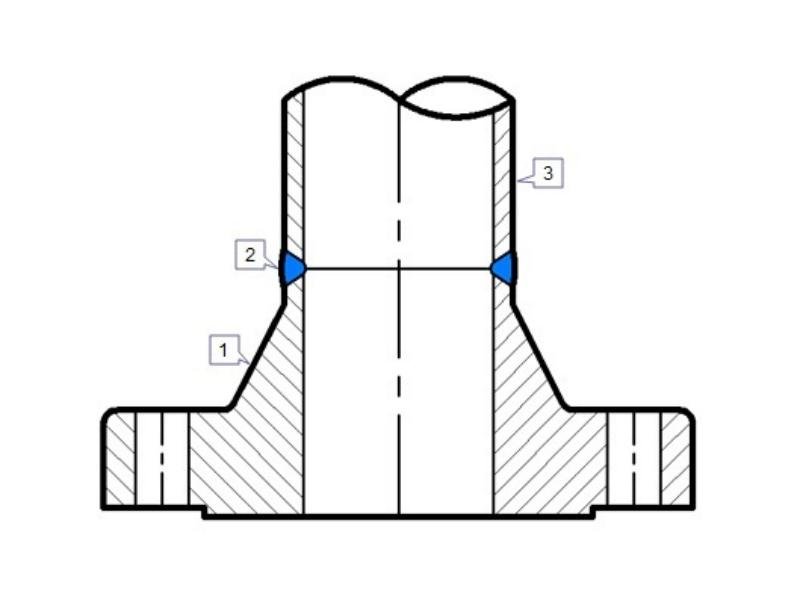
1.Weld Neck flange 2.Butt Weld 3.Pipe or Fitting
Weld Neck Flanges are the most widely used flange type because they provide the strongest butt-welded connection that becomes an integral part of the pipe, ensuring smooth stress transfer and excellent stress distribution through their tapered hub design. This structure minimizes stress concentration and significantly reduces the risk of leakage when combined with RF or RTJ sealing faces.
They are suitable for all pressure classes from Class 150 to Class 2500 and even high-pressure API services up to 10,000 PSI, making them ideal for severe operating conditions commonly found in the oil and gas, chemical, petrochemical, power generation, and offshore industries.
Standards & Dimensions
Weld Neck Flanges are manufactured according to:
ASME Standards
- ASME B16.5 → ½” to 24″
- ASME B16.47 Series A/B → 26″ to 60″
- MSS-SP-44 → Large diameter
- API 6A / API 17D → High-pressure oil & gas
- DIN EN 1092-1 Type 11
Pressure Ratings
- Class 150 / 300 / 400 / 600 / 900 / 1500 / 2500
- API 2000 / 5000 / 10000 / 15000 PSI
Facing Types
- RF (Raised Face)
- RTJ (Ring Type Joint)
- FF (Flat Face)
Benefits and Limitations
Weld Neck Flanges offer several key advantages, including high structural strength from the butt-welded joint, excellent resistance to fatigue and vibration, and smooth stress transition thanks to the tapered neck that reduces stress concentration. They are ideal for high-temperature and high-pressure applications such as steam, oil, gas, refinery, and subsea systems, and are widely available across major standards like ASME, API, DIN, JIS, and EN, making sourcing and replacement easy.
However, Weld Neck Flanges also have several disadvantages, such as higher overall cost due to forging, machining, and welding processes, and the need for skilled, qualified welders as required by ASME IX. Installation takes more time because it involves weld preparation, alignment, and NDT inspections, and the flanges are heavier because of their thicker tapered hub, which increases both material and handling requirements.
How Weld Neck (WN) Flanges Are Made
Weld Neck flanges are the most commonly used flange type in piping systems, especially suitable for high-pressure, high-temperature, and corrosive environments. Their manufacturing process strictly follows ASME B16.5 standard dimensions and pressure ratings, ensuring flange strength, sealing performance, and long-term reliability. Below is the manufacturing workflow using typical carbon steel or stainless steel WN flanges as an example:
1. Raw Material Selection
- Select materials based on design requirements and service conditions, referring to the ASME B16.5 material table, such as carbon steel ASTM A105 / A350 LF2, stainless steel ASTM A182 F304/F316, and duplex stainless steel ASTM A182 F51/F53.
- Typically, forged round bars are used as raw material to ensure flange strength and toughness.
2. Forging
- Heat the round bar billet to 1000–1250℃ and forge it on a press or hammer machine to form the flange blank, including the tapered neck portion.
- Forging increases metal density, reduces porosity and inclusions, and ensures mechanical performance and pressure resistance.
3. Machining (in accordance with ASME B16.5 dimensions)
The machining stage strictly follows ASME B16.5 dimensional standards to ensure full compatibility with the piping system:
- Outer diameter machining: Control the flange outer diameter (OD) within standard tolerances.
- Inner bore machining: Machine the tapered neck bore to match the pipe’s inner diameter (ID), ensuring smooth stress transition during welding.
- Facing: Machine RF (Raised Face), FF (Flat Face), or RTJ (Ring Type Joint) sealing surfaces to guarantee sealing performance and flatness.
- Bolt hole machining: Drill or mill bolt holes according to ASME B16.5, including hole diameter, quantity, and bolt circle (BC), ensuring reliable installation.
4. Heat Treatment
- For carbon or alloy steels, perform annealing, normalizing, or quenching & tempering to relieve internal stress and improve toughness.
- Stainless steels may undergo solution annealing to enhance corrosion resistance.
5. Surface Treatment
- Apply surface protection such as polishing, pickling, phosphating, or oil coating to prevent rust during storage and transportation.
6. Inspection and Testing
- Dimensional inspection: Verify outer diameter, inner diameter, thickness, bolt holes, and flange face flatness to ensure compliance with ASME B16.5.
- Non-destructive testing (NDT): Use ultrasonic testing (UT), radiographic testing (RT), or magnetic particle testing (MT) to detect internal defects.
Pressure testing: Conduct hydrostatic or pneumatic tests to confirm the flange’s pressure capacity and sealing performance.
Weld Neck (WN) Flange Installation & Maintenance
Weld Neck Flanges are widely used in high-temperature, high-pressure, and corrosive piping systems due to their high strength and pressure resistance. Proper installation and regular maintenance are crucial to ensure safe operation of the piping system.
1. Installation Steps
1. Inspect Flange and Pipe
- Verify flange material, size, and pressure rating meet design requirements (refer to ASME B16.5).
- Check flange surfaces, tapered bore, and bolt holes for flatness and damage.
2. Prepare the Pipe
- Ensure pipe ends are cut square and ground smooth.
- Ensure the pipe fits the flange bore; the tapered neck should closely match the pipe.
3. Welding
- Perform butt welding for carbon steel or alloy steel flanges. Clean surfaces and align the pipe before welding.
- Welding must be done by a qualified welder following ASME Section IX welding procedures.
- Post-weld heat treatment (e.g., tempering or solution annealing) may be applied to relieve residual stress.
4. Flange Facing and Bolt Installation
- Position the flange facing the sealing side and place the gasket (RF or RTJ type).
- Tighten bolts evenly in a cross/diagonal sequence (star pattern) to ensure uniform flange load.
- Tighten bolts to the required torque according to specifications.
5. System Pressure Test
- After installation, conduct hydrostatic or pneumatic testing to confirm no leakage.
- Test pressure should comply with design requirements and ASME B16.5 standards.
2. Maintenance Guidelines
1. Regular Inspection
- Check bolt tightness and re-torque if necessary.
- Inspect flange gasket for wear or damage and replace when needed.
2. Corrosion Protection
- Apply anti-rust coating or oil on carbon steel flanges regularly.
- Stainless steel or alloy flanges should be cleaned periodically to prevent surface corrosion.
3. Monitor Operating Conditions
- Avoid exposing the pipeline to overpressure or abnormal temperatures.
- Monitor corrosive media changes and apply protective measures as necessary.
4. Weld Inspection
- Conduct periodic non-destructive testing (UT, RT) or visual inspection of welds; address cracks or corrosion immediately.
FAQs – Weld Neck Flange
WN is butt-welded (high strength) while SO is fillet welded (lower strength).
Use WN in high-pressure, high-temperature, cyclic loading, or corrosive systems.
A variant with an extended neck used for vessels, nozzles, and high-pressure equipment.
RTJ offers superior sealing at high pressure and high temperature.
Common tests: RT, UT, MT, PT depending on project requirements.
To distribute stress evenly and prevent fatigue failure.
Conclusion
Weld Neck Flanges (WN flanges) are the most reliable and widely used flange type in modern piping systems, offering unmatched strength, smooth stress distribution, and excellent sealing performance. From precise manufacturing under ASME B16.5 standards to proper installation and routine maintenance, WN flanges are ideal for critical applications in oil & gas, petrochemical, power generation, and offshore industries.
By understanding their benefits, limitations, and correct handling, engineers can ensure long-term system integrity, reduce leakage risks, and maintain safe and efficient operation under high-pressure, high-temperature, and corrosive conditions. Proper selection and care of WN flanges ultimately guarantee durability, safety, and peak performance in demanding environments.