
Threaded Flanges, also called Screwed Flanges, are widely used in piping systems where welding is undesirable or impractical. Known for their simple installation, mechanical connection via threads, and suitability for low- to medium-pressure systems, threaded flanges are commonly applied in chemical, water, gas, and instrumentation pipelines, as well as flammable or explosive environments where welding is unsafe.
Compared with Weld Neck and other flange types, Threaded Flanges do not require welding at the flange itself. Instead, the flange has internal threads that match the pipe’s external threads, creating a strong mechanical connection. This feature is especially valuable for small-diameter systems, temporary piping, or pipelines that require frequent disassembly.
This article explains what a Threaded Flange is, where it is used, its advantages and limitations, available standards, installation guidelines, maintenance steps, and answers to frequently asked questions.
What Is a Threaded Flange (Screwed Flange)?
A Threaded Flange is a single-piece flange with a threaded bore that matches the external threads of a pipe. The pipe is screwed into the flange, creating a mechanical connection without welding.
Threaded Flange Structure Includes:
- Threaded bore (female thread)
- Flange body
- Raised Face (RF), Flat Face (FF), or sometimes RTJ sealing face
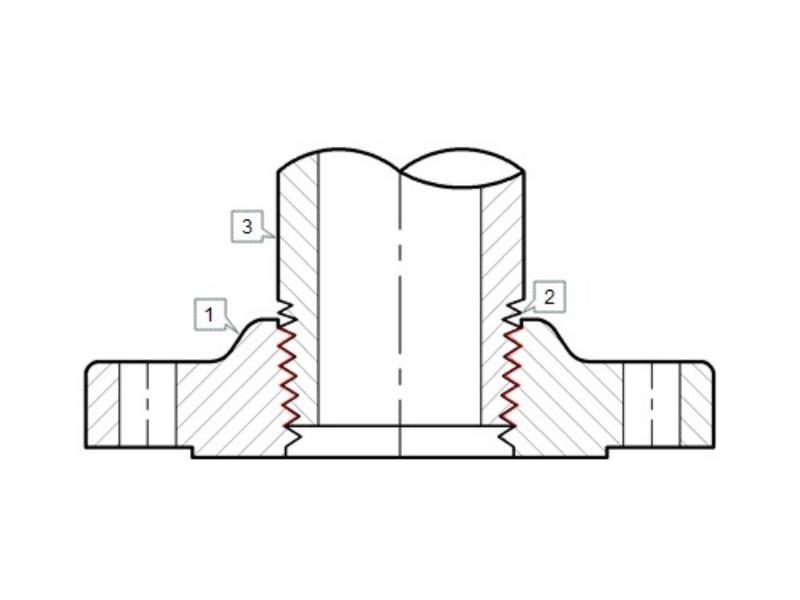
1.Threaded flange 2.Thread 3.Pipe or Fitting
Standards & Dimensions
| Standard | Size Range | Pressure Rating / Class | Notes |
| ASME B16.5 | NPS ½″ – 24″ | Class 150 – 2500 | Most widely used threaded flange standard; covers low- to medium-pressure lines |
| API 605 | ½″ – 2″ (small-bore only) | Up to 10,000 PSI | Mainly for instrumentation and high-pressure small-diameter lines |
| EN 1092-1 | DN 10 – DN 100 | PN 6 – PN 40 | European standard for low- to medium-pressure piping |
| DIN 2576 / DIN 2999 | DN 10 – DN 100 | PN 10 – PN 40 | German industrial piping standard |
| JIS B2220 | 15A – 100A | 10K / 16K | Commonly used in Asian markets |
| ISO / BS / GOST | Small to large diameters | Various PN/Class ratings | International standards; dimensions may vary slightly |
Notes on Threaded Flange Size Range
- Threaded flanges are mainly used for small-diameter pipes, typically NPS ½″ to 2″ (DN 10–50), although some standards cover up to 24″ for low-pressure applications.
- They are generally limited to low- and medium-pressure systems because thread connections are weaker than welded joints.
- Facing types are usually RF (Raised Face), occasionally FF (Flat Face), and rarely RTJ for very high-pressure small-bore applications.
Benefits and Limitations
Advantages
- No welding required → safer for flammable or explosive environments
- Easy to install, remove, and replace
- Suitable for small-diameter pipelines
- Can be used in corrosive systems if proper materials are chosen
Limitations
- Limited to low- to medium-pressure applications
- Weaker than welded connections
- Not suitable for high-temperature or cyclic loading
- Risk of leakage if threads are damaged or improperly sealed
Applications
- Small-bore chemical or oil pipelines
- Gas distribution lines
- Fire-fighting systems
- Corrosion-resistant piping using alloys (stainless steel, nickel alloys)
- Temporary or portable piping systems
FAQs – Lap Joint Flange
Threaded Flanges are connected to the pipe using matching threads; no welding is required. They are suitable for low- to medium-pressure systems and small-diameter pipelines.
- Weld Neck Flanges are butt-welded to the pipe, providing higher structural strength, better fatigue resistance, and suitability for high-pressure, high-temperature, or cyclic-loading applications.
- When welding is not possible or unsafe (e.g., flammable/explosive environments).
- For small-diameter pipelines (typically ≤ 2″ or DN 50).
- When frequent disassembly, maintenance, or replacement is needed.
- For temporary or portable piping systems.
Generally no. Threaded flanges are designed for low- to medium-pressure systems. High-pressure or high-temperature service can cause thread failure or leakage, so welded flanges are preferred for such conditions.
- Use proper thread sealants such as PTFE tape, pipe dope, or anaerobic thread sealants.
- Ensure threads are clean and undamaged before assembly.
- Hand-tighten the pipe and then use a wrench to achieve the recommended torque without over-tightening, which could strip threads.
- Yes, but material compatibility is important.
- Use stainless steel, nickel alloys, or other corrosion-resistant materials for the flange or the mating pipe to avoid galvanic corrosion.
- Ensure threads are properly coated or treated if corrosive media are present.
Conclusion
Threaded Flanges are a reliable choice for low- to medium-pressure systems where welding is not feasible. While they are not suitable for high-pressure, high-temperature, or cyclic-service applications, correctly selected and installed threaded flanges ensure safe operation, convenient disassembly, and long-lasting performance. Understanding their structure, benefits, limitations, and applications helps engineers select the right flange type for small-diameter and sensitive piping systems.