Socket Weld Flange

Socket Weld Flanges (SW flanges) are widely used in small-diameter, high-pressure piping systems, especially where superior leakage integrity and excellent fatigue performance are required. Known for their structural strength and clean internal weld profile, SW flanges are commonly used in high-pressure steam, chemical processing, hydraulic systems, instrumentation lines, and refinery services.

Compared with Slip On and other flange types, Socket Weld Flanges provide a stronger connection due to their combination of socket fit-up and a single external fillet weld, making them ideal for small-bore, high-integrity pipelines.
This article explains what a Socket Weld Flange is, where it is used, its advantages and limitations, available standards, manufacturing process, installation guidelines, maintenance steps, and answers to frequently asked questions.

What Is a Socket Weld Flange (SW Flange)?

A Socket Weld Flange (SW Flange) is a forged flange type designed with a recessed socket in the bore. The pipe is inserted into the socket until it bottoms out, then pulled back slightly to allow for thermal expansion before being secured with a single fillet weld around the pipe’s outer circumference.

Because the pipe sits inside the socket, it creates a smooth internal bore and reduces turbulence and erosion, making Socket Weld Flanges especially suitable for high-pressure and high-temperature small-diameter piping.
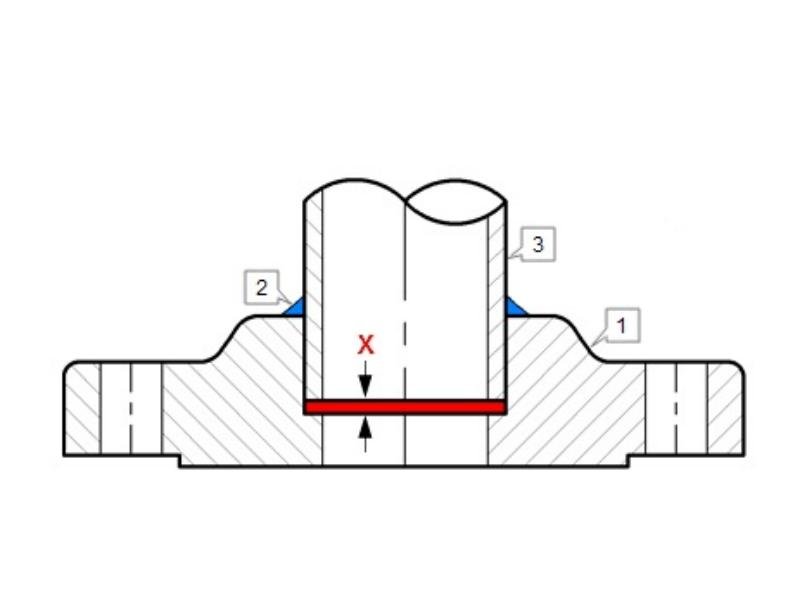
Socket Weld Flange

1.Socket Weld flange 2.Filled weld 3.Pipe X = Expansion gap

Socket Weld Flanges are commonly used for pipe sizes ½″ to 2″ and are preferred where welding strength, cleanliness of flow, and high integrity are critical.

Standards & Dimensions

StandardSize RangePressure RatingRemarks
ASME B16.5NPS ½″–2″Class 150–2500Mainstream option
EN 1092-1 Type 12DN 10–100PN 6–40Common in European standards
DIN 2564/2565DN 10–100PN 16–40Widely used in the German market
JIS B222015A–100A10K / 16K / 20KCommon in the Asian market
API 6ASmall-bore instrumentation2000–15000 PSIHigh-pressure service

Benefits and Limitations

Socket Weld Flanges offer excellent mechanical strength thanks to the recessed socket design, which ensures accurate pipe alignment and provides better fatigue resistance than Slip On flanges. Their smooth internal bore reduces flow turbulence and is ideal for small-diameter, high-pressure piping.

However, Socket Weld Flanges have limitations. They are not suitable for large pipe diameters and require precise weld clearance to avoid weld defects or stress cracking. The socket area may trap media, making SW flanges less suitable for corrosive or hygienic applications such as food or pharmaceutical systems.

FAQs – Socket Weld Flange

SW flanges provide stronger joints due to the socket design and are intended for high-pressure small-diameter lines, while SO flanges are lower cost and for low–medium pressure.

When the pipeline is small-bore (≤2″) and requires high leakage integrity, strong structural strength, and smooth flow.

To allow thermal expansion and prevent weld cracking, as mandated by ASME.

To provide adequate strength and prevent leakage.

Conclusion

Socket Weld Flanges (SW flanges) are robust, reliable, and ideal for small-diameter, high-pressure piping systems. Their recessed socket design ensures precise pipe alignment, improved fatigue resistance, and a clean internal bore for reduced turbulence. This makes them a preferred choice in applications such as steam lines, chemical plants, hydraulic systems, and high-pressure oil & gas piping.

Although SW flanges are not suitable for large pipe diameters or corrosive media that can accumulate in the socket, they provide excellent performance when properly selected, installed, and maintained. Understanding their structure, advantages, limitations, and application scenarios allows engineers to make informed decisions and ensure long-term system safety and efficiency.

Share:

Products We Offer

Send Us A Message

Scroll to Top

Send an inquiry now