
Slip On Flanges (SO flanges) are one of the most commonly used flange types in general-purpose piping systems. Known for their simple structure, easy installation, and low manufacturing cost, SO flanges are widely applied in low- to medium-pressure pipelines across industries such as water treatment, HVAC, chemical processing, and fire-fighting systems.
Compared with high-strength Weld Neck Flanges (WN), Slip On Flanges provide moderate pressure resistance and easier alignment during installation, making them an ideal choice where frequent assembly and disassembly are needed.
This article explains what a Slip On Flange is, why it is widely used, its advantages and limitations, available standards, manufacturing process, installation guidelines, maintenance steps, and answers to frequently asked questions.
What Is a Slip On Flange (SO Flange)?
A Slip On Flange (SO Flange) is a type of pipe flange designed to slip over the pipe’s outside diameter and is then secured by two fillet welds — one inside and one outside.
Because the pipe passes through the flange bore, alignment is easier, making SO flanges a preferred option for systems that require simple and quick installation.
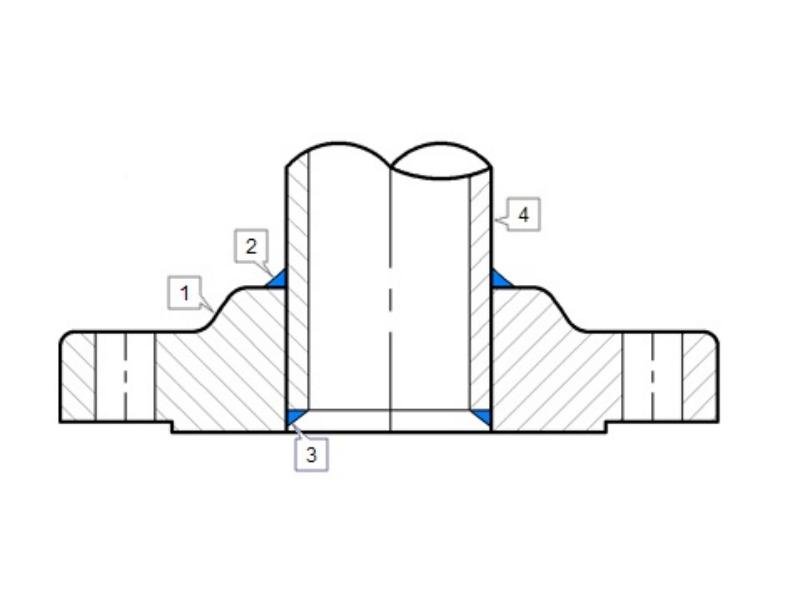
1.Slip On flange 2.Filled weld outside 3.Filled weld inside 4.Pipe
SO flanges are commonly used in low-pressure or non-critical piping because the fillet welds do not provide the same structural strength as butt-welded connections. However, their cost-effectiveness and versatility make them one of the most widely used flange types in commercial and industrial applications.
Standards & Dimensions
ASME Standards
- ASME B16.5 → ½” to 24″
- ASME B16.47 Series A/B → 26″ to 60″
- MSS-SP-44 → Larger diameters
- API 605 (replaced by ASME B16.47)
International Standards
- EN 1092-1 Type 01
- DIN 2576 / DIN 2502
- JIS B2220 – 5K/10K/16K
- GOST / BS / ISO Standards
Pressure Ratings
- Class 150 / 300 / 400 / 600 (rare above Class 600)
- PN 2.5 / 6 / 10 / 16 / 25 / 40
Facing Types
- RF (Raised Face) – most common
- FF (Flat Face) – for cast iron equipment
- RTJ – less common, used for higher pressure
Benefits and Limitations
Slip-On flanges are easy to install and align because the pipe can be adjusted inside the flange bore before welding. They have lower cost, require less machining, and are widely available under most global standards. They are ideal for low-pressure systems and help reduce installation time.
However, Slip-On flanges provide lower mechanical strength since they rely on fillet welds rather than a full penetration butt weld. They are not suitable for high-pressure, high-temperature, or cyclic loading conditions and have a higher potential leak path at the welds, with increased risk of corrosion at the fillet weld zone—especially in corrosive services.
FAQs – Slip On Flange
- SO → Easier to install, lower strength, for low pressure
- WN → Highest strength, for high pressure and high temperature
When cost is a priority and system pressure/temperature is moderate.
Generally not. They are rarely used above Class 600.
To provide adequate strength and prevent leakage.
Yes, but uncommon — RTJ is mainly used with WN flanges.
Conclusion
Slip On Flanges (SO flanges) are economical, easy-to-install, and ideal for low- to medium-pressure piping systems. Their simple structure, wide availability, and low cost make them one of the most commonly used flange types in industrial and commercial applications.
Although SO flanges lack the structural strength of butt-welded WN flanges and are not suitable for high-pressure or high-temperature service, when correctly manufactured, installed, and maintained, they deliver excellent performance and reliability.
By understanding their characteristics, limitations, and proper usage, engineers can select the right flange type to ensure system safety, durability, and efficiency in a wide range of operating environments.