
PREN (Pitting Resistance Equivalent Number) Guide: Corrosion Resistance of Stainless and Duplex Steels

PREN (Pitting Resistance Equivalent Number) is a composition-based indicator used to evaluate the pitting corrosion resistance of austenitic, duplex, and super duplex stainless steels in chloride-containing environments.

This article explains the PREN calculation formula, material reference tables, causes of pitting, and material selection guidance to help engineers quickly choose steels suitable for seawater, chemical, and high-chloride applications.

What Is Pitting Resistance Equivalent Number (PREN)?

Pitting Resistance Equivalent Number (PREN) is an indicator used to evaluate the pitting corrosion resistance of stainless steels, especially austenitic, duplex, and super duplex stainless steels.

PREN is an empirical value calculated from chemical composition, representing the material’s ability to resist pitting in chloride-containing environments. A higher PREN value indicates stronger pitting resistance.

What Is Pitting Corrosion?

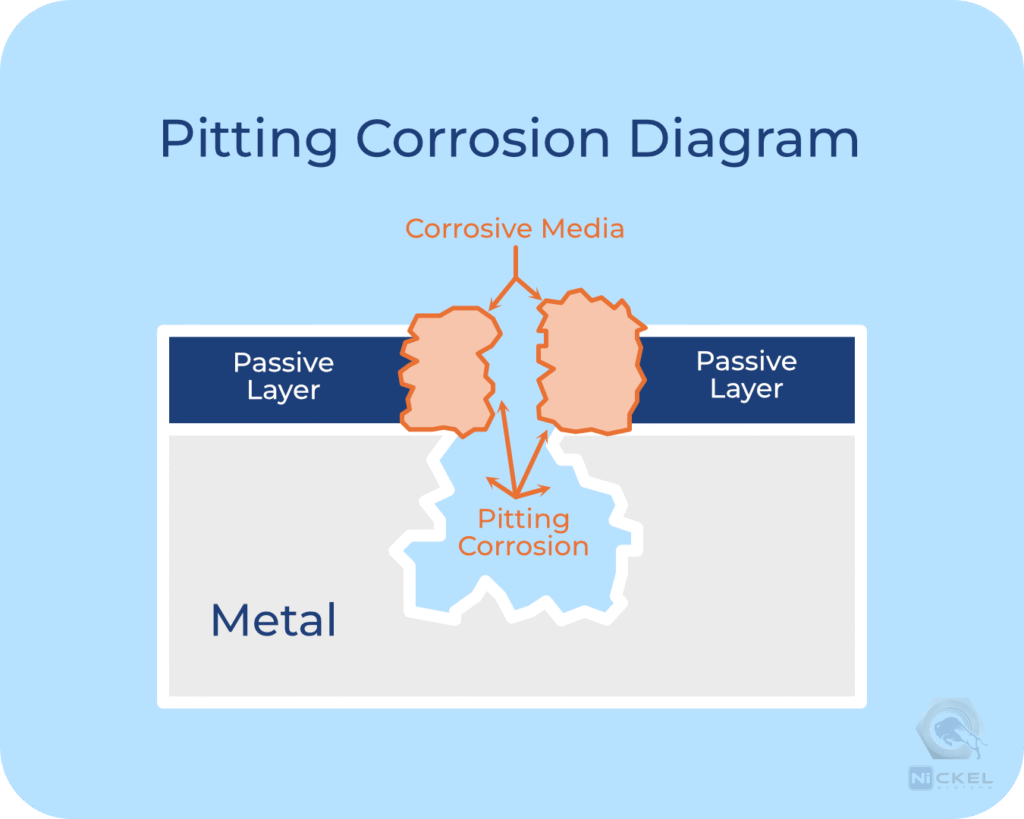
Pitting Corrosion is a localized corrosion phenomenon, where small but deep pits or holes form on the metal surface, causing rapid local material loss even if the overall surface appears largely intact. Pitting corrosion is more dangerous than general uniform corrosion because it can penetrate the material locally at a fast rate.

The causes of pitting corrosion are mainly related to the breakdown of the protective film on the material surface and the local chemical environment. Stainless steel and other corrosion-resistant metals typically have a dense oxide layer (such as chromium oxide). When this protective layer is locally damaged or penetrated, pitting may initiate. Chloride ions (Cl⁻) in seawater, salt solutions, or chemical media can penetrate the oxide layer, creating a local acidic environment and accelerating corrosion. High temperatures increase oxide film dissolution and reaction rates, enhancing pitting tendencies.

 

PREN

PREN Calculation Formula

For austenitic or duplex stainless steels (classic formula):

PREN=

Where:

  • Cr = Chromium content (%)
  • Mo = Molybdenum content (%)
  • N = Nitrogen content (%)

Extended formula (including tungsten W):

PREN

Where: W = Tungsten content (%)
Adding W provides a more accurate prediction of super duplex stainless steel performance in chloride environments.

PREN Table for Stainless and Duplex Steels


Steel TypeCr %Mo %N %PREN
Ferritic
43016.0–18.0NSNS16.0–18.0
43416.0–18.00.9–1.4NS19.0–22.6
44117.5–18.5NSNS17.5–18.5
44417.0–20.01.8–2.5≤0.0323.0–28.7
Austenitic
30417.5–19.5NS≤0.1117.5–20.8
304LN17.5–19.5NS0.12–0.2219.4–23.0
316 / 316L16.5–18.52.0–2.5≤0.1123.1–28.5
316L (Mo ≥2.5%)17.0–19.02.5–3.2≤0.1125.3–30.7
316LN16.5–18.52.0–2.50.12–0.2225.0–30.3
904L19.0–21.04.0–5.0≤0.1532.2–39.9
Sanicro 2824.0–26.03.0–4.0≤0.1135.9–43.0
254SMO19.5–20.56.0–7.00.18–0.2542.2–47.6
1925H19.0–21.06.0–7.00.15–0.2541.2–48.1
4565S24.0–26.04.0–5.00.30–0.6042.0–52.1
Duplex
2202220.40.226.5
2101 LDX21.0–22.00.1–0.80.20–0.2524.5–28.6
SAF 230422.0–24.00.1–0.60.05–0.2023.1–29.2
SAF 220521.0–23.02.5–3.50.10–0.2230.8–38.1
SAF 250724.0–26.03.0–4.00.24–0.3540+
Zeron 10024.0–26.03.0–4.00.20–0.3040+
Ferrinox 25524.0–26.03.0–4.00.20–0.3040+

Notes:

  • PREN = Cr + 3.3×Mo + 16×N (some steels include W correction)
  • NS = Not Specified
  • Duplex steels usually have PREN ≥ 30, significantly improving resistance to pitting and crevice corrosion.
  • High-PREN materials are suitable for seawater, chemical, or high-chloride environments.

Conclusion

PREN is a fast, quantitative, and intuitive tool for evaluating pitting corrosion resistance, making it suitable for preliminary material selection and comparison. However, it cannot fully replace real-world corrosion testing or comprehensive engineering judgment. It helps engineers compare different steel grades, select appropriate materials for chloride-containing environments, and optimize design and cost. PREN applies to austenitic, duplex, and super-austenitic steels as an effective initial screening metric.

However, PREN has limitations. It is only a theoretical reference value, ignoring actual manufacturing processes, welding defects, or mechanical damage. It reflects only pitting and crevice corrosion trends, not uniform corrosion, stress corrosion, or hydrogen embrittlement. It also overlooks environmental factors such as chloride concentration, temperature, pH, and flow rate. Therefore, PREN should not be the sole basis for material selection; real operating conditions, mechanical properties, weldability, and economic factors must be considered comprehensively.

Share:

Products We Offer

Send Us A Message

Scroll to Top

Send an inquiry now