Lap Joint Flange

Lap Joint Flanges (LJ flanges) are commonly used in piping systems that require frequent disassembly, servicing, or alignment adjustments. Known for their two-piece design — a forged backing flange paired with a Lap Joint Stub End — LJ flanges offer outstanding flexibility during installation and are widely used in stainless steel, corrosion-resistant, and sanitary applications.

Compared with Weld Neck and other flange types, Lap Joint Flanges do not require welding directly on the flange itself. The pipe is butt-welded to a stub end, while the backing flange rotates freely, making alignment significantly easier. This feature is especially valuable in large-diameter or high-corrosion piping systems.

This article explains what a Lap Joint Flange is, where it is used, its advantages and limitations, available standards, manufacturing process, installation guidelines, maintenance steps, and answers to frequently asked questions.

What Is a Lap Joint Flange (LJ Flange)?

A Lap Joint Flange (LJ flange) is a two-piece flange assembly consisting of:

Stub End (welded to the pipe)

Backing Flange (loose / rotating ring)

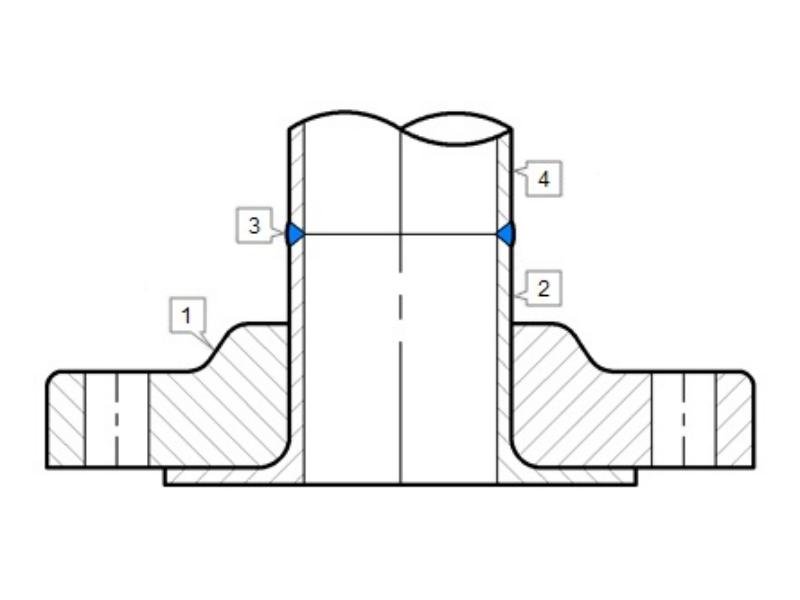
The pipe is welded to the stub end using a butt-weld. After welding, the backing flange slides over the stub end’s raised “lap” (flare), allowing it to rotate freely.

Because the flange is not welded to the pipe, alignment is extremely easy — especially in confined areas or large piping systems. The loose-type connection also helps reduce stress at the joint.

Lap Joint Flange structure includes:

  • Stub End
  • Back-up Flange / Loose Flange
  • Welded Pipe Connection

lap joint flange

1.Lap Joint flange 2.Stub End 3.Butt weld 4.Pipe or Fitting

Lap Joint Flanges are typically used where corrosion resistance is needed internally but cost must be controlled — for example, using a carbon steel backing flange with a stainless steel stub end.

Standards & Dimensions

StandardSize RangePressure Rating / Class RangeRemarks
ASME B16.5NPS ½″–24″Class 150–2500Most commonly used LJ flange standard; similar to SO dimensions but with a radius back
ASME B16.47 Series A/B26″–60″Class 150 / 300 (typical)Used for large-diameter systems; does not cover sizes below 26″
MSS-SP-44Large diametersHigh pressure classesMainly for high-pressure oil & gas applications
EN 1092-1 Type 02DN 10–2000PN 2.5 / 6 / 10 / 16 / 25 / 40Common European standard; used with Type B/C Stub Ends
DIN 2641DN 10–DN 200PN 6Older DIN standard; gradually replaced by EN 1092
DIN 2642DN 10–DN 200PN 10Same as above, legacy standard
JIS B222015A–150A10K / 16KCommonly used in Asian markets
ISO / BS / GOSTSmall–large diametersVarious PN/Class ratingsInternational standards; dimensions may vary slightly

Benefits and Limitations

Lap Joint Flanges offer excellent alignment capability because the backing flange rotates freely around the stub end. This makes installation easy and reduces assembly time, especially for large-diameter pipelines. They also help reduce overall material cost — the stub end uses a corrosion-resistant alloy while the backing flange can be carbon steel. Additionally, LJ flanges are ideal for systems requiring frequent dismantling, inspection, or cleaning.

However, Lap Joint Flanges provide lower mechanical strength compared with Weld Neck flanges because the flange itself is not welded to the pipe. They are not ideal for high-pressure or high-stress piping systems. The contact surface between the stub end and backing flange may allow slight movement under load, making them unsuitable for cyclic or vibrating service. For very corrosive media, stub-end surfaces must be carefully selected to avoid wear or galling.

FAQs – Lap Joint Flange

LJ flanges use a loose backing flange with a welded stub end, while SO flanges are welded directly to the pipe with fillet welds.

When frequent dismantling is required, or when alignment accuracy is important, or when internal corrosion resistance is needed at lower cost.

Yes — this is one of the main cost-saving benefits of LJ flanges.

Not recommended for high-pressure or cyclic-fatigue environments due to lower structural rigidity.

Yes — the stub end is essential; the backing flange cannot be used alone.

Conclusion

Lap Joint Flanges (LJ flanges) are flexible, economical, and ideal for piping systems requiring frequent disassembly, precise alignment, or corrosion-resistant internal surfaces. Their two-piece design provides installation convenience and cost efficiency, especially in stainless steel or lined piping systems.

Although they are not suitable for high-pressure or high-vibration applications, correctly selected and installed LJ flanges deliver long-lasting performance with reduced installation effort and lower overall material cost. Understanding their structure, advantages, limitations, and application areas helps engineers choose the most suitable flange type for safe and efficient piping system design.

Share:

Products We Offer

Send Us A Message

Scroll to Top

Send an inquiry now