
Blind Flanges are solid, disc-shaped flanges used to close the ends of piping systems, valves, or equipment nozzles. They are commonly applied in systems where access to the pipeline is not required, for pressure testing, or to isolate sections of the pipeline. Known for their simplicity, strength, and ability to withstand high pressure, Blind Flanges are widely used in chemical, water, gas, and oil pipelines, as well as in high-pressure or high-temperature applications.
Compared with other flange types, Blind Flanges do not have a bore or opening. Instead, they provide a solid seal, making them ideal for capping pipelines or pressure-containing vessels. This feature is especially valuable for maintenance, testing, or temporary closures in both small- and large-diameter systems.
This article explains what a Blind Flange is, where it is used, its advantages and limitations, available standards, installation guidelines, maintenance steps, and answers to frequently asked questions.
What Is a Blind Flange?
A Blind Flange is a flat, solid flange that closes off the end of a pipe, nozzle, or valve. It can withstand high pressures and is typically bolted to mating flanges using gaskets for sealing.
Blind Flange Structure Includes:
- Solid flange body
- Bolt holes around the perimeter
- Raised Face (RF), Flat Face (FF), or Ring-Type Joint (RTJ) sealing face
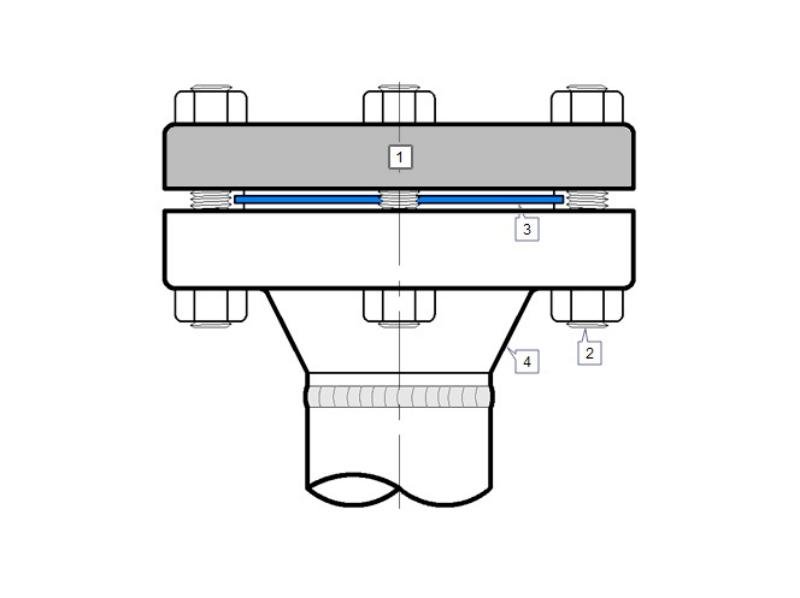
1.Blind flange 2.Stud Bolt 3.Gasket 4.Other flange
Standards & Dimensions
| Standard | Size Range | Pressure Rating / Class | Notes |
| ASME B16.5 | NPS ½″ – 24″ | Class 150 – 2500 | Most commonly used for standard pressure piping |
| ASME B16.47 Series A/B | 26″ – 60″ | Class 150 / 300 | Used for large-diameter systems |
| EN 1092-1 | DN 10 – DN 2000 | PN 2.5 – PN 40 | European standard for low- to high-pressure piping |
| DIN 2631 / DIN 2632 | DN 10 – DN 200 | PN 6 – PN 40 | German industrial piping standard |
| JIS B2220 | 15A – 150A | 10K / 16K | Commonly used in Asian markets |
| ISO / BS / GOST | Small to large diameters | Various PN/Class ratings | International standards; dimensions may vary slightly |
Notes on Blind Flange Size Range:
- Blind Flanges can be used for both small- and large-diameter pipes.
- They are suitable for low- to very high-pressure applications, depending on the material and rating.
- Facing types are usually RF (Raised Face), FF (Flat Face), or RTJ (Ring-Type Joint) for high-pressure or API services.
Benefits and Limitations
Advantages
- Provides a solid seal to close pipelines or equipment nozzles
- Can withstand high-pressure and high-temperature conditions
- Ideal for pressure testing or isolating sections of a system
- Available in various materials for corrosive or extreme service
Limitations
- Does not allow flow; must be removed for access to the pipeline
- Heavier and harder to handle for large diameters
- Installation requires proper bolt tightening and gasket selection
- Not suitable for systems requiring frequent flow changes at the closure point
Applications
- Closing the end of pipelines in chemical, water, oil, and gas systems
- Isolating sections of a pipeline for maintenance or repair
- Pressure testing of piping systems
- Equipment nozzle closures
- Temporary or permanent pipeline capping
FAQs – Lap Joint Flange
- Blind Flanges are solid discs used to close the end of a pipe or nozzle, without any bore. They provide a seal but do not allow flow.
- Weld Neck Flanges have a bore and are butt-welded to the pipe, designed to maintain smooth stress distribution for high-pressure or high-temperature applications.
- When you need to terminate or isolate a pipeline.
- For pressure testing a pipeline.
- To close off equipment nozzles or temporarily seal a system during maintenance.
Yes, when properly selected according to material, pressure rating, and standards (e.g., ASME B16.5 or API 6A), blind flanges can handle both high-pressure and high-temperature conditions.
- Use the correct gasket type for the flange rating (RF, FF, or RTJ).
- Tighten bolts in a cross/star pattern to achieve uniform load and prevent leakage.
- Inspect flange faces for flatness and damage before installation.
Yes, if the flange material (e.g., stainless steel, alloy steel, or corrosion-resistant material) is selected based on the service medium and operating conditions.
Conclusion
Threaded Flanges are a reliable choice for low- to medium-pressure systems where welding is not feasible. While they are not suitable for high-pressure, high-temperature, or cyclic-service applications, correctly selected and installed threaded flanges ensure safe operation, convenient disassembly, and long-lasting performance. Understanding their structure, benefits, limitations, and applications helps engineers select the right flange type for small-diameter and sensitive piping systems.