In industrial piping systems, flanges are among the most essential, widely used, and critical connecting components. Whether in oil and gas, chemical processing, power plants, water treatment, or general industrial pipelines, various types of flanges play a vital role. They not only connect pipes and equipment but also determine the overall sealing performance, operational safety, and long-term reliability of the system.
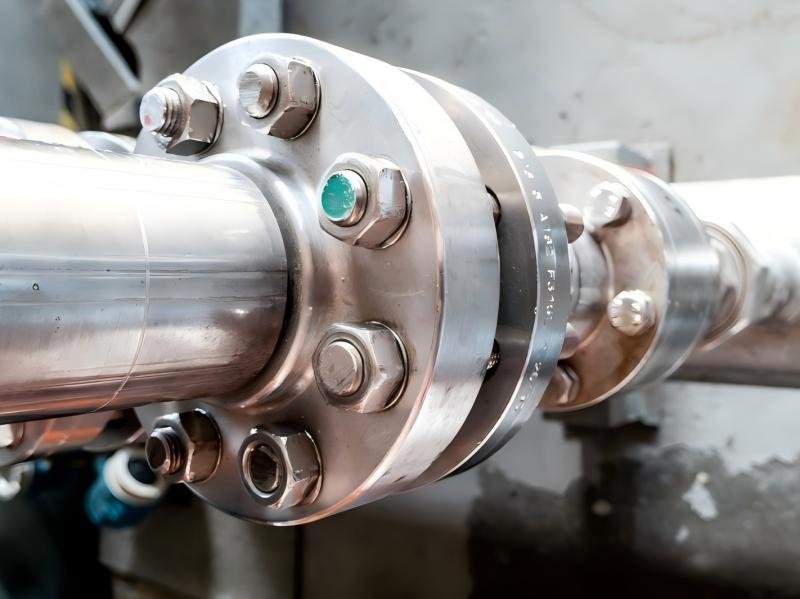
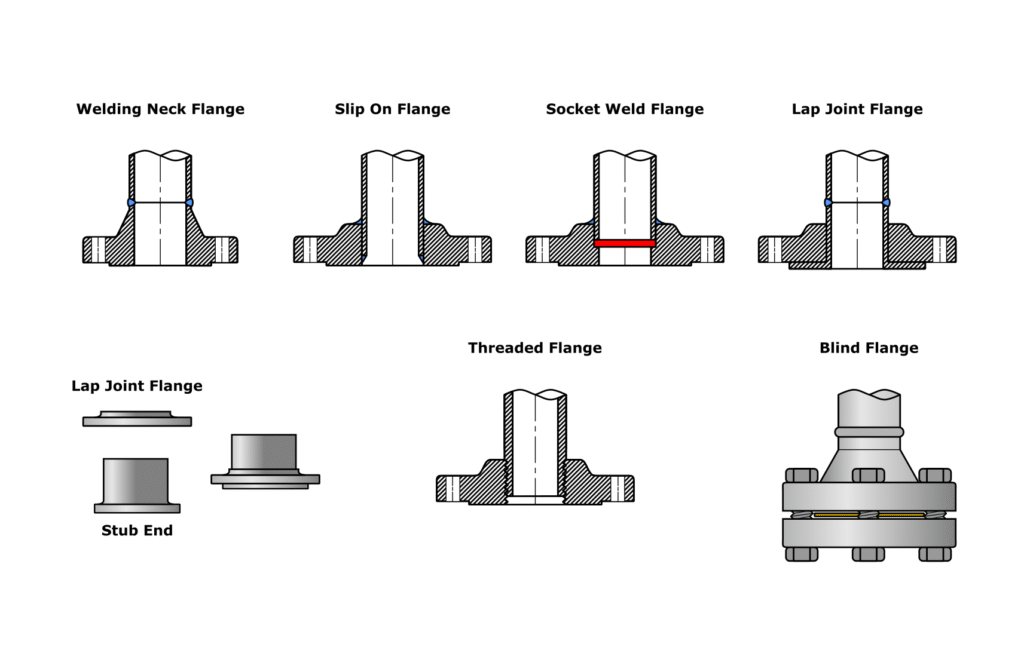
Weld Neck Flange (WN)
A Weld Neck Flange (WN) is a high-strength flange with a long neck that requires butt welding to the pipe. It has the highest pressure-bearing capacity, widest application range, and highest reliability among all flange types. It is commonly used in high-temperature, high-pressure, corrosive, or leakage-prone working conditions.
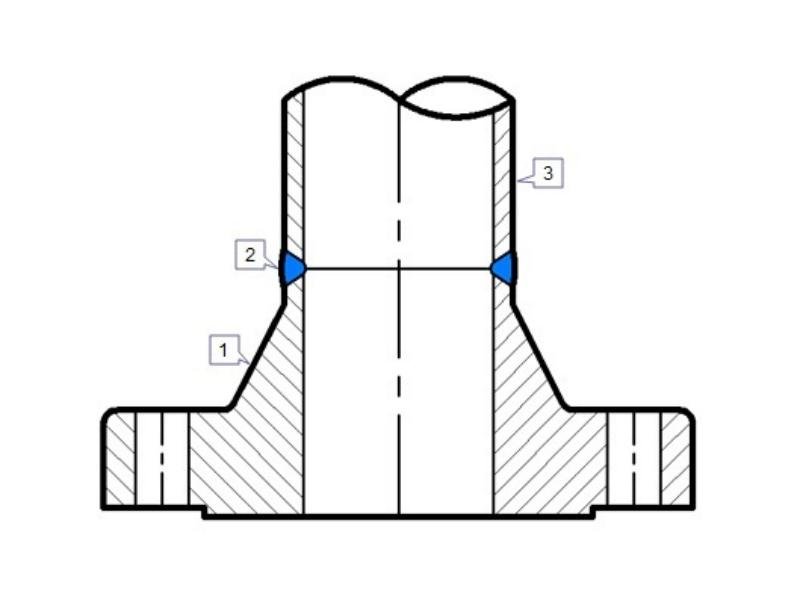
1.Weld Neck flange 2.Butt Weld 3.Pipe or Fitting
Long Weld Neck Flange (LWN)
A Long Weld Neck Flange (LWN) is a special weld neck flange with an extra-long hub. It is not directly welded to a pipe but used as a replacement for a short pipe (Nozzle) + weld neck flange. The neck length can be customized based on design requirements, and it is widely used in pressure vessels, heat exchangers, storage tanks, and similar equipment as nozzle connections.
Slip On Flange (SO)
In a Slip On Flange, the pipe can “slip into” the flange bore and is then welded on both the inside and outside. It is one of the most commonly used and lowest-cost flange types, especially suitable for medium and low pressure, non-critical systems. Therefore, commonly used pressure classes are Class 150/300 (Class 600 is possible but not recommended).
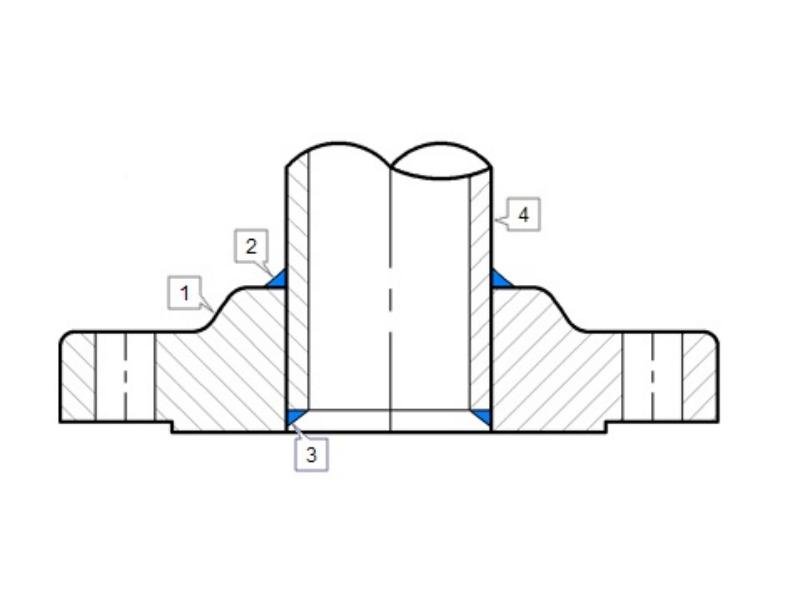
1.Slip On flange 2.Filled weld outside 3.Filled weld inside 4.Pipe
Socket Weld Flange (SW)
A Socket Weld Flange has a socket (a recessed step) at the center of the flange. The pipe is inserted into the socket and then welded from the outside. It combines the simple installation of the Slip On Flange with the higher pressure performance of the Weld Neck Flange. It is typically used for small-diameter (1/2″ ~ 4″) high-pressure pipelines.
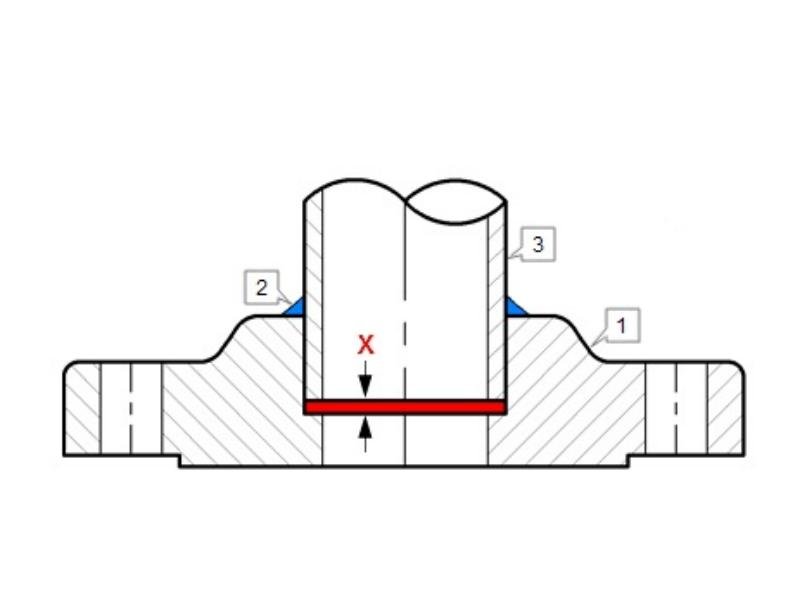
1.Socket Weld flange 2.Filled weld 3.Pipe X = Expansion gap
Lap Joint Flange
A Lap Joint Flange (LJ Flange) is a type of flange that does not directly contact the fluid. It is used together with a Stub End, which contains the actual sealing surface. The flange itself is loose / free to rotate, so it is also called a Loose Flange or Slip-on Backing Flange.
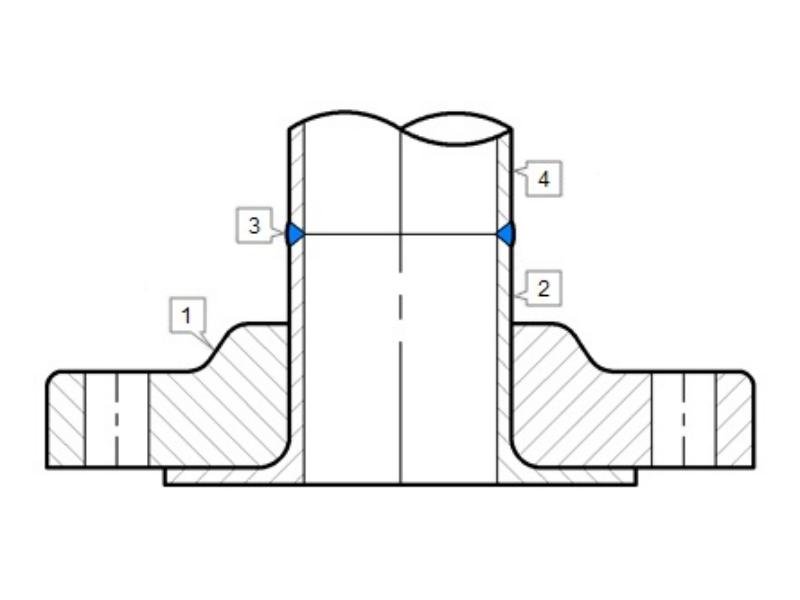
1.Lap Joint flange 2.Stub End 3.Butt weld 4.Pipe or Fitting
Threaded Flange
A Threaded Flange has internal pipe threads in the bore. The pipe with external threads can be directly screwed in without welding. It is suitable for low pressure, ambient temperature, and situations where welding is not allowed or not convenient. Common sizes: 1/2″ ~ 4″ (large sizes are rarely used).
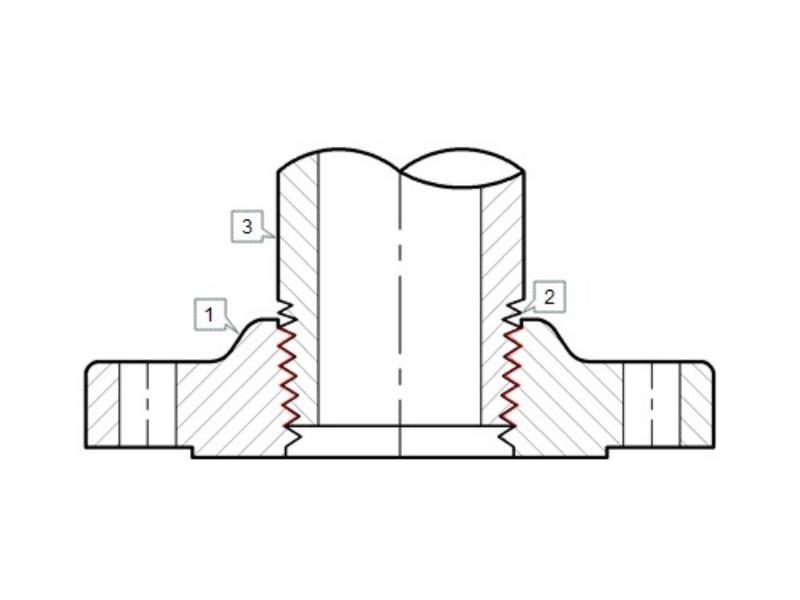
1.Threaded flange 2.Thread 3.Pipe or Fitting
Blind Flange (BL)
A Blind Flange has no center bore and is used to block the end of pipes, pressure vessels, or equipment. It acts like a “cover” to seal off the pipeline completely. It can be matched with WN/SO/SW or other flange types and has one of the highest pressure ratings among all flange types. It is especially suitable for locations requiring frequent opening, inspection, testing, or cleaning.
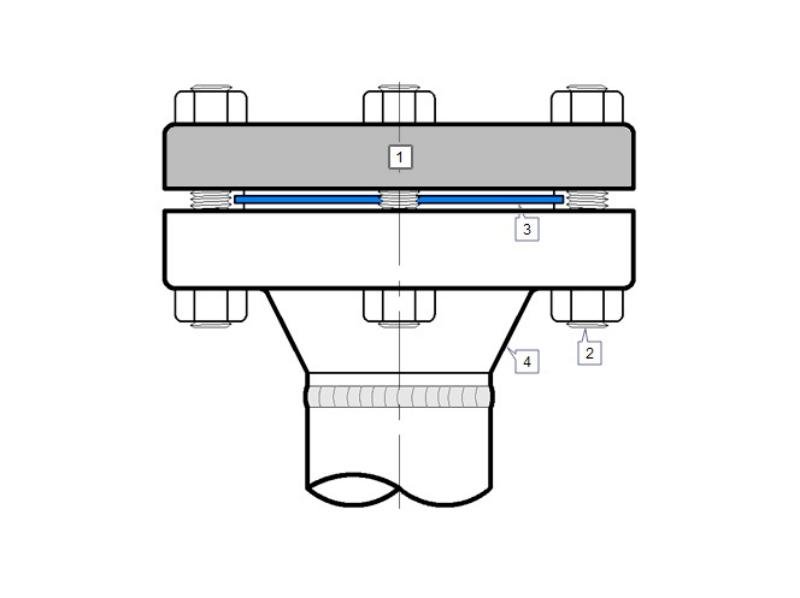
1.Blind flange 2.Stud Bolt 3.Gasket 4.Other flange
Other Flange Types (Extended Types)
In addition to WN, SO, BL, SW, threaded flanges, and lap joint flanges, there are more than 30 extended types such as expander/reducer flanges, orifice flanges, sanitary flanges, vacuum flanges, AWWA flanges, API flanges, TEMA heat-exchanger flanges, tongue-and-groove / male-female sealing flanges, spectacle blinds, etc., used in different industries and working conditions.
ASME B16.5 Flanges
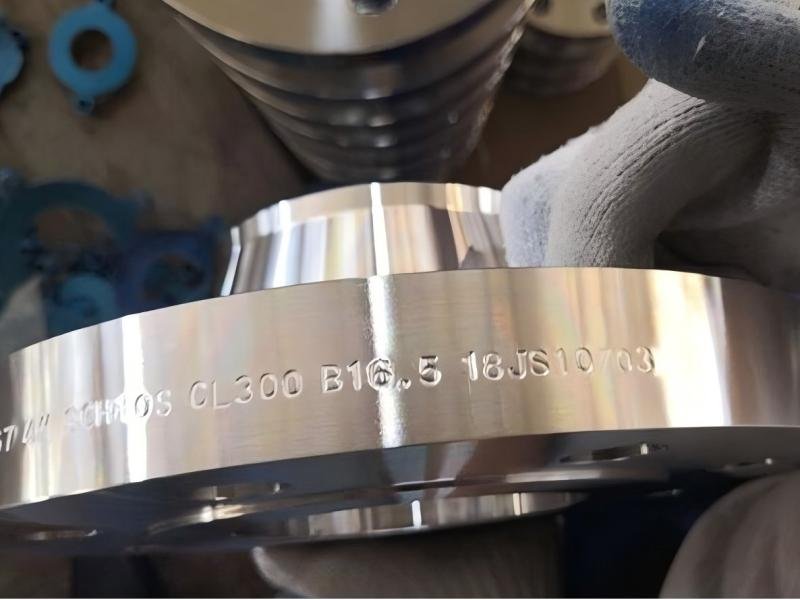
ASME B16.5 is issued by the American Society of Mechanical Engineers (ASME). It is the most important standard for flanges and flange covers ranging from 2″–24″ in piping systems.
ASME B16.5 defines industrial flange dimensions, pressure classes (Class 150, 300, 400, 600, 900, 1500, 2500), and materials including carbon steel, stainless steel, alloy steel, and nickel alloys, as well as sealing faces (RF, RTJ, FF).
Nearly all industrial piping systems use ASME B16.5 because it ensures interchangeability and safety compliance among flanges manufactured by different suppliers.
ASME B16.47 Flanges
If ASME B16.5 covers 1/2″–24″, ASME B16.47 specifically covers 26″–60″. This standard mainly includes Weld Neck Flanges and Blind Flanges (BL). All large-diameter piping systems typically use ASME B16.47.
ASME B16.47 has two series:
- Series A (formerly MSS SP-44): Used for high-pressure, high-demand systems. These flanges are thicker, heavier, have more bolt holes, and handle higher pressure. Suitable for oil, offshore, chemical, and other demanding applications.
- Series B (formerly API 605): Thinner, lighter, fewer bolts, and more cost-effective. Commonly used in general industrial pipelines.
EN 1092-1 Flanges (European Standard)
EN 1092-1 is Europe’s primary piping flange standard issued by CEN. It specifies flange dimensions, structures, sealing faces, materials, and tolerances for PN-rated metric flanges.
Almost all piping equipment used in the European market follows EN 1092-1.
American Standard → ASME B16.5 / B16.47
European Standard → EN 1092-1
They are not interchangeable and must not be mixed.
EN 1092-1 flange types include:
- Type 01 Slip On Flange
- Type 11 Weld Neck Flange
- Type 13 Threaded Flange
- Type 05 Blind Flange
- Type 34 Socket Weld Flange
- Type 01 + Type 21/31 Lap Joint Flange
More than 30 different structures.
Pressure rating PN2.5–PN400 (most common: PN10, PN16, PN25, PN40).
Sealing faces include:
Form A (FF), Form B1/B2 (RF), Form C/D (Male/Female), Form E/F (Tongue & Groove), Form G/H (RTJ-type).
DIN Flanges (German Standard)
DIN flanges follow German national standards. Although EN 1092-1 is more widely used in the EU, many German industries still use DIN standards extensively.
Core standards:
- DIN 2631–2638 (PN6–PN160 Weld Neck Flanges)
- DIN 2573/2576 Slip On Flanges
- DIN 2565/2566 Threaded Flanges
- DIN 2527 Blind Flanges
- DIN 2642/2643 Lap Joint Flanges
Commonly used in machinery, chemical plants, water treatment, and shipbuilding.
JIS / KS Flanges (Japan / Korea)
JIS B2220 pressure ratings: 5K, 10K, 16K, 20K, 30K — supports SO, WN, BL, threaded, and lap joint types.
KS B1503 (Korea) is almost fully interchangeable with JIS.
Widely used in water treatment, shipbuilding, HVAC, and general industry.
GB Flanges (China National Standard)
GB flanges use the DN + PN system.
Main standards:
- GB/T 9112–9124 (metal flange series)
- GB/T 17241.6 (water supply flanges)
- HG/T 20592 (chemical industry standard)
The structure is similar to ASME/EN but the dimensions are not interchangeable.
AWWA Flanges (Waterworks Flanges)
Defined by AWWA C207 for low-pressure water systems (86–300 psi).
Characteristics:
- Simple structure
- Thinner and lighter
- Available in large diameters (up to 60″)
Common materials: A36, A283-C, 304, 316
Not suitable for high-pressure steam or petrochemical applications.