CRA Alloys refers to Corrosion-Resistant Alloy.
It is not a single material, but a family of metal alloys with excellent corrosion resistance, widely used in seawater, acidic environments, oil & gas fields, and chemical industries. The key feature of CRA is its ability to resist pitting, crevice corrosion, chloride corrosion, and acidic corrosion.
How to determine if a metal is CRA
- Contains ≥ 12% chromium to form a self-passivating protective layer
- Examples: 304 / 316 / 2205
- Nickel-based high corrosion-resistant alloys
- Examples: Inconel 625, Hastelloy C-276
- Exceptional resistance to pitting and crevice corrosion
- Alloys with PREN > 40 are generally considered CRA
Importance of CRA in the Oil & Gas Industry
- Used in H₂S-containing sour environments, high-chloride seawater, and high CO₂ corrosion conditions
- Main applications: flanges, valves, pipelines, downhole tools, and wellhead equipment
Typical CRA Material Families
A. Austenitic Stainless Steels
| UNS | ASTM Standard | Key Composition (wt%) | PREN* | Typical Applications | Corrosion Resistance |
| S30400 (304) | A182 / A240 | 18Cr-8Ni | 18–19 | General piping, food industry, low-corrosion systems | ⭐ |
| S30403 (304L) | A182 / A240 | 18Cr-8Ni-low C | 18–19 | Pressure vessels, welded structures | ⭐ |
| S31600 (316) | A182 / A240 | 17Cr-12Ni-2.5Mo | 24–26 | Marine, chemical, flanges | ⭐⭐ |
| S31603 (316L) | A182 / A240 | 17Cr-12Ni-2.5Mo-low C | 24–26 | Acidic media, welded flanges | ⭐⭐ |
| S31703 (317L) | A182 / A240 | 18Cr-13Ni-3.5Mo | 29–30 | Stronger pitting resistance | ⭐⭐⭐ |
| N08904 (904L) | A182 / A240 | 20Cr-25Ni-4.5Mo | 35–36 | High-chloride environments, seawater condensers | ⭐⭐⭐ |
PREN = Cr + 3.3Mo + 16N
⭐ Basic resistance
⭐⭐ Moderate resistance
⭐⭐⭐ Strong resistance
B. Duplex & Super Duplex Stainless Steels
| UNS | ASTM Standard | Key Composition | PREN | Typical Applications | Corrosion Resistance |
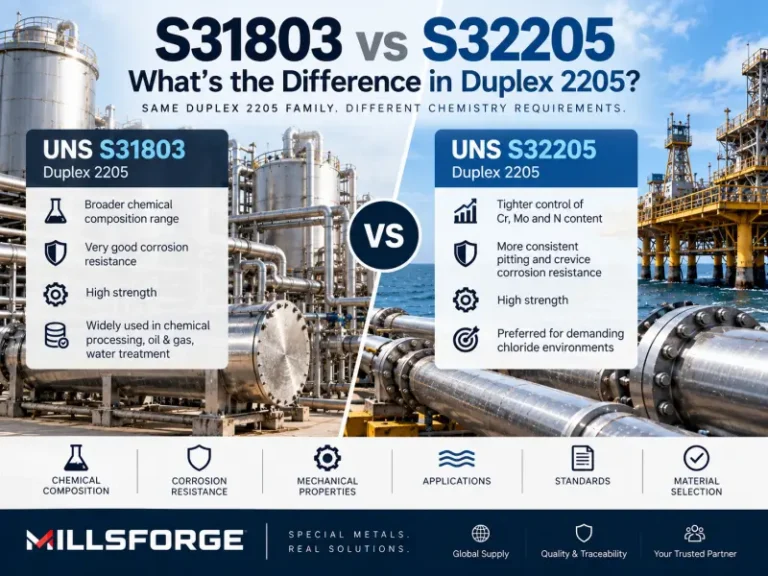
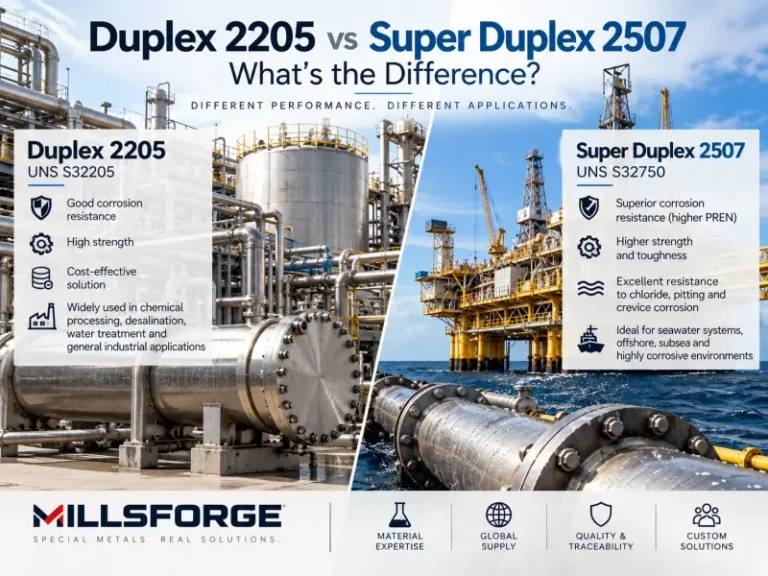
| S31803 / S32205 (2205) | A182 | 22Cr-5Ni-3Mo-N | 32–35 | Marine systems, subsea, wellhead flanges | ⭐⭐⭐ |
| S32750 (2507) | A182 | 25Cr-7Ni-4Mo-N | 40–43 | High-chloride seawater, subsea pipelines | ⭐⭐⭐⭐ |
| S32760 (Zeron 100) | A182 | 25Cr-7Ni-3.5Mo-W | 42–45 | Subsea equipment, sour service components | ⭐⭐⭐⭐ |
Super Duplex is commonly used in offshore platforms, seawater lift pumps, manifolds, X-mas tree components.
C. Nickel-Based High-Performance Alloys (CRA)
| UNS | ASTM Standard | Key Composition | PREN | Typical Applications | Corrosion Resistance |
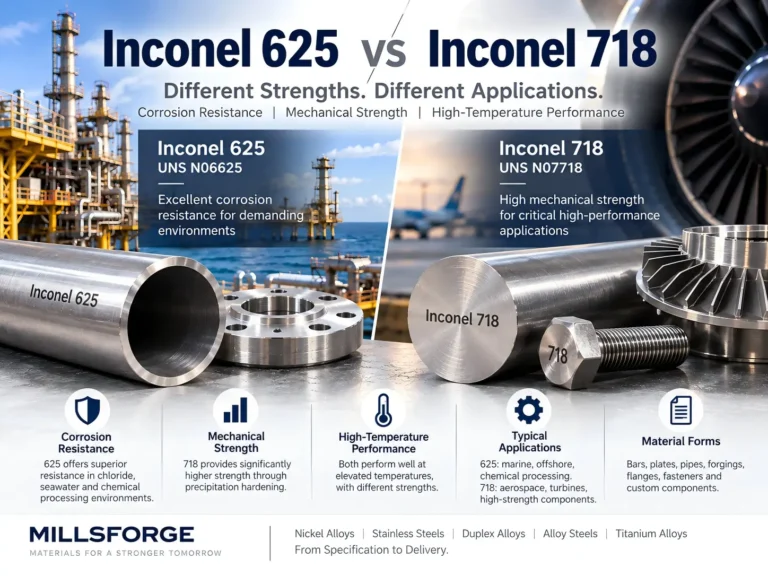
| N06625 (Inconel 625) | B446 / B564 | Ni-Cr-Mo-Nb | 45–50 | Sour wells, H₂S/CO₂, wellhead parts, springs | ⭐⭐⭐⭐⭐ |
| N08825 (Incoloy 825) | B423 / B564 | Ni-Fe-Cr-Mo-Cu | 32–35 | Sour service, sulfuric acid, seawater exchangers | ⭐⭐⭐⭐ |
| N10276 (Hastelloy C-276) | B574 / B564 | Ni-Cr-Mo-W | 58–60 | Strong acids, oxidizing chloride media | ⭐⭐⭐⭐⭐ |
| N04400 (Monel 400) | B164 / B564 | Ni-Cu | 28–30 | Seawater systems, pumps, valves | ⭐⭐⭐⭐ |
Inconel 625 and Hastelloy C-276 are top-tier CRA alloys suitable for HPHT sour gas wells and extreme chloride environments.
D. High-Alloy Austenitic Stainless Steels (Super Austenitic)
| UNS | ASTM Standard | Composition | PREN | Applications | Corrosion Resistance |
| S31254 (254SMO) | A182 | 20Cr-18Ni-6Mo-N | 42–45 | Seawater pumps, evaporators, desalination | ⭐⭐⭐⭐ |
| S34565 (AL-6XN) | A182 | 21Cr-24Ni-6Mo-N | 45–48 | Seawater coolers, pharmaceutical, chemical | ⭐⭐⭐⭐ |
E. Titanium Alloys (CRA Metals)
| Grade | UNS | ASTM | Key Composition | Typical Applications | Corrosion Resistance |
| Ti Grade 2 | R50400 | B348 | Commercially pure Ti | Seawater, chemical heat exchangers | ⭐⭐⭐⭐ |
| Ti Grade 5 (Ti-6Al-4V) | R56400 | B348 | Ti-6Al-4V | High strength, downhole tools, aerospace | ⭐⭐⭐⭐ |
| Ti Grade 7 | R52400 | B348 | Ti-Pd alloy | Extreme chloride pitting resistance | ⭐⭐⭐⭐⭐ |
Corrosion Resistance Rating Guide
| Rating | Suitable Environments |
| ⭐ | Fresh water, low-corrosion service |
| ⭐⭐ | Mild acids/alkalis, low chloride |
| ⭐⭐⭐ | Medium chloride (<10,000 ppm), chemical process |
| ⭐⭐⭐⭐ | Seawater, desalination, H₂S/CO₂ |
| ⭐⭐⭐⭐⭐ | Strong acids, extreme chloride, HPHT sour wells |
Conclusion
Corrosion-Resistant Alloys (CRA) encompass a wide range of metals—including austenitic and duplex stainless steels, super-austenitic stainless steels, nickel-based alloys, and titanium—that are engineered for exceptional resistance to corrosion in harsh environments. These materials are selected based on their chemical composition, PREN rating, and application requirements, making them essential for industries such as oil & gas, seawater systems, chemical processing, and high-chloride or acidic environments.
CRAs provide reliable long-term performance in aggressive environments, with each alloy family offering specific strengths in pitting, crevice, chloride, or acid resistance. Choosing the right CRA ensures safety, durability, and cost-effectiveness in demanding applications.